@ Renault Group Media
@ Volkswagen AG / VW Media
VS

Renault Symbioz vs VW Taigo – Performance, range & efficiency compared

Both models have their strengths – but which one suits you more?
Compare performance, efficiency, price and space directly: Renault Symbioz or VW Taigo?

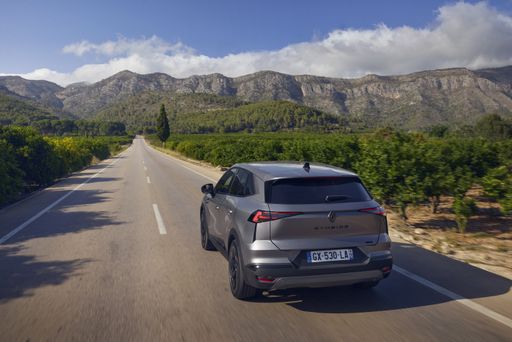
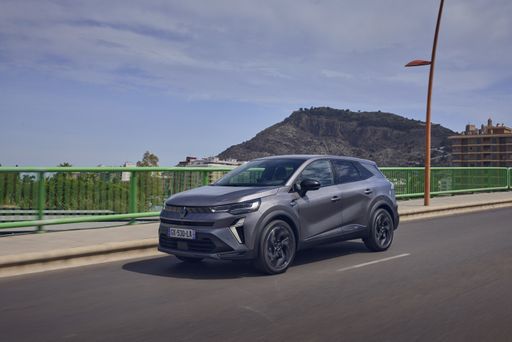
Symbioz @ Renault Group Media

In the ever-evolving world of SUVs, the Renault Symbioz and VW Taigo stand out as two compelling options for consumers looking for a combination of style, efficiency, and modern technology. Both vehicles cater to the needs of different drivers, but with their unique features and innovations, they offer a fascinating comparison. In this article, we will dive into the technical specifications and innovations that distinguish these two models.
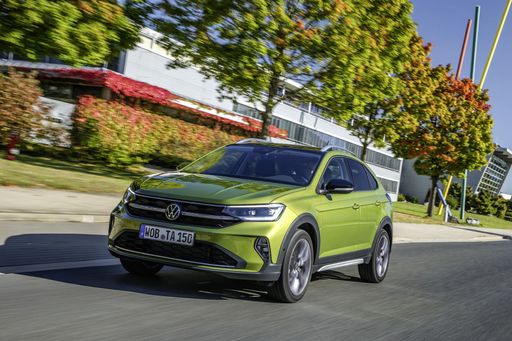
Taigo @ Volkswagen AG / VW Media

Design and Dimensions

Starting with the dimensions, the Renault Symbioz has a length of 4413 mm, width of 1797 mm, and a height of 1575 mm. This gives it a robust presence on the road. In contrast, the VW Taigo is slightly smaller, measuring 4266 mm in length, 1757 mm in width, and 1518 mm in height. While both vehicles share a sleek SUV design, the Symbioz projects a more muscular aesthetic, while the Taigo leans towards a sporty, coupe-like silhouette.

Symbioz @ Renault Group Media

Performance and Powertrain

The Renault Symbioz is powered by a full hybrid engine that delivers 143 HP and 250 Nm of torque. It features a front-wheel-drive setup and an automatic gearbox that allows for seamless gear transitions. The impressive fuel consumption of 4.8 L/100 km and a CO2 emission rating of 109 g/km make it an environmentally friendly choice.

On the other hand, the VW Taigo offers a variety of petrol engines, with power outputs ranging from 95 HP to 150 HP. Its torque varies from 175 Nm up to 250 Nm, depending on the engine selected. The Taigo provides consumers with options for both manual and dual-clutch automatic transmissions, catering to different driving preferences. Although its fuel consumption ranges from 5.4 to 5.8 L/100 km and CO2 emissions are slightly higher, with figures from 123 g/km to 132 g/km, the Taigo still manages to deliver a fun driving experience.

Taigo @ Volkswagen AG / VW Media

Acceleration and Top Speed

When it comes to performance metrics, the Renault Symbioz achieves 0-100 km/h in 10.6 seconds with a maximum speed of 170 km/h. The smoothness of its hybrid technology provides a remarkable acceleration feature in an efficient package.

In comparison, the VW Taigo offers varying acceleration figures depending on the engine. The most powerful variant can sprint from 0-100 km/h in just 8.2 seconds, with a top speed of 212 km/h. This makes the Taigo a more potent option for those who prioritize performance.

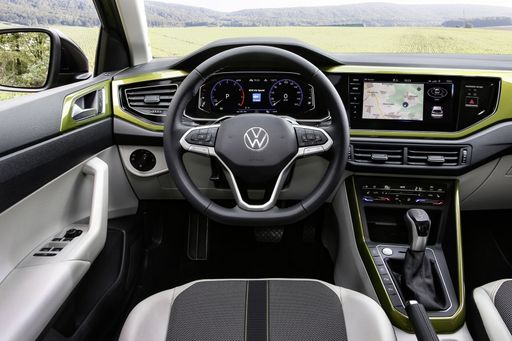
Symbioz @ Renault Group Media

Interior and Technology

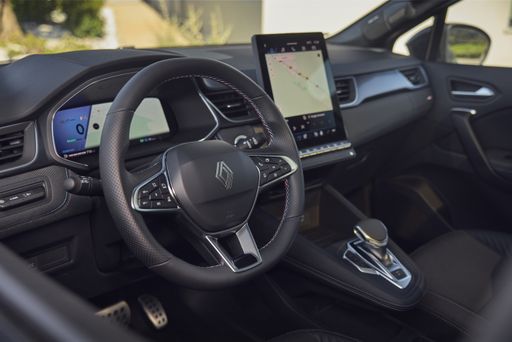
Both models accommodate five passengers comfortably. The Renault Symbioz shines with its spacious trunk capacity of 492 liters, providing ample room for luggage and other necessities. In terms of interior technology, it features an advanced infotainment system aimed at delivering a seamless connected driving experience.

The VW Taigo, while slightly less in trunk volume at 440 liters, is equipped with a modern interior that emphasizes usability and user experience. VW’s infotainment system includes cutting-edge connectivity options and driver-assistance features that enhance safety and convenience.

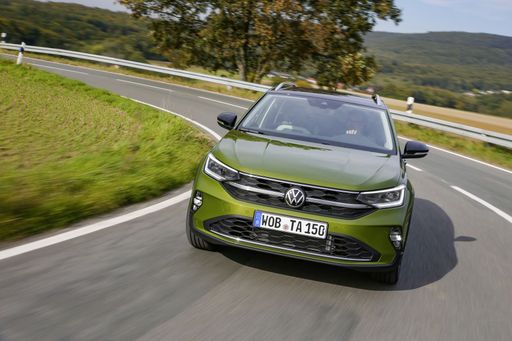
Taigo @ Volkswagen AG / VW Media

Safety and Efficiency

In the realm of safety, both models come equipped with standard safety features that are designed to protect both the driver and passengers. The Renault Symbioz earns a CO2 efficiency class rating of ‘C’, while the VW Taigo holds a ‘D’ rating. This distinction underlines the Symbioz's commitment to sustainability, aligning with the growing demand for eco-friendly vehicles.

Conclusion: Which SUV Reigns Supreme?

Choosing between the Renault Symbioz and VW Taigo boils down to personal preferences and priorities. For drivers seeking an efficient hybrid SUV with eco-friendliness at its core, the Symbioz offers unbeatable innovation and practicality. Conversely, for performance enthusiasts who appreciate a sporty feel and flexible engine options, the VW Taigo presents a very attractive alternative.

Ultimately, both vehicles embody the spirit of modern SUV design while bringing their unique strengths to the table, ensuring a competitive choice for aspiring SUV owners.

Here’s where it gets real: The technical differences in detail

Costs and Efficiency:

Price and efficiency are key factors when choosing a car – and this is often where the real differences emerge.

VW Taigo has a noticeable advantage in terms of price – it starts at 19600 £, while the Renault Symbioz costs 24400 £. That’s a price difference of around 4804 £.

Fuel consumption also shows a difference: Renault Symbioz manages with 4.50 L and is therefore a bit more efficient than the VW Taigo with 5.30 L. The difference is about 0.80 L per 100 km.

Engine and Performance:

Power, torque and acceleration are the classic benchmarks for car enthusiasts – and here, some clear differences start to show.

When it comes to engine power, the Renault Symbioz has a barely noticeable edge – offering 158 HP compared to 150 HP. That’s roughly 8 HP more horsepower.

In acceleration from 0 to 100 km/h, the VW Taigo is a bit quicker – completing the sprint in 8.20 s, while the Renault Symbioz takes 9.10 s. That’s about 0.90 s faster.

In terms of top speed, the VW Taigo performs to a small extent better – reaching 212 km/h, while the Renault Symbioz tops out at 180 km/h. The difference is around 32 km/h.

There’s also a difference in torque: Renault Symbioz pulls barely noticeable stronger with 265 Nm compared to 250 Nm. That’s about 15 Nm difference.

Space and Everyday Use:

Whether family car or daily driver – which one offers more room, flexibility and comfort?

Both vehicles offer seating for 5 people.

In curb weight, VW Taigo is somewhat lighter – 1229 kg compared to 1359 kg. The difference is around 130 kg.

In terms of boot space, the Renault Symbioz offers distinct more room – 576 L compared to 440 L. That’s a difference of about 136 L.

In maximum load capacity, the Renault Symbioz performs distinct better – up to 1682 L, which is about 460 L more than the VW Taigo.

When it comes to payload, Renault Symbioz minimal takes the win – 459 kg compared to 457 kg. That’s a difference of about 2 kg.

Who comes out on top?

Overall, the Renault Symbioz shows itself to be leaves the rival little chance and secures the title of DriveDuel Champion.
It convinces with the more balanced overall package and proves to be the more versatile choice for everyday use.

from about £24,400
Symbioz @ Renault Group Media

Renault Symbioz

  • Engine Type : Full Hybrid, Petrol MHEV
  • Transmission : Automatic, Manuel
  • Drive Type : Front-Wheel Drive
  • Power HP : 140 - 158 HP
  • Consumption L/100km : 4.5 - 6 L

Renault Symbioz

The Renault Symbioz feels less like a traditional car and more like a rolling living room that's been told it's allowed to drive — its flowing lines and minimalist cabin are pure concept-car theatre that teases the future of everyday transport. For buyers with an eye for design and a taste for tech-forward ideas, the Symbioz is an alluring vision of what Renault could offer tomorrow, even if it's not yet a model you can park in your driveway.

details

VW Taigo

5 (1)
rate

The VW Taigo brings coupe-like flair to the compact crossover scene with sharp styling and an interior that punches above its price, feeling smarter than you’d expect. It’s an easygoing daily companion that balances comfort and practicality with a playful wink, perfect for city drivers who want something livelier than a regular hatchback.

details
Renault Symbioz
VW Taigo
Symbioz @ Renault Group Media
Taigo @ Volkswagen AG / VW Media

Costs and Consumption

Price
24400 - 30700 £
Price
19600 - 31300 £
Consumption L/100km
4.5 - 6 L
Consumption L/100km
5.3 - 5.8 L
Consumption kWh/100km
-
Consumption kWh/100km
-
Electric Range
-
Electric Range
-
Battery Capacity
-
Battery Capacity
-
co2
102 - 136 g/km
co2
120 - 132 g/km
Fuel tank capacity
48 L
Fuel tank capacity
40 L

Dimensions and Body

Body Type
SUV
Body Type
SUV
Seats
5
Seats
5
Doors
5
Doors
5
Curb weight
1359 - 1544 kg
Curb weight
1229 - 1302 kg
Trunk capacity
492 - 576 L
Trunk capacity
440 L
Length
4413 mm
Length
4266 mm
Width
1797 mm
Width
1757 mm
Height
1575 mm
Height
1518 mm
Max trunk capacity
1582 - 1682 L
Max trunk capacity
1222 L
Payload
376 - 459 kg
Payload
448 - 457 kg

Engine and Performance

Engine Type
Full Hybrid, Petrol MHEV
Engine Type
Petrol
Transmission
Automatic, Manuel
Transmission
Manuel, Automatic
Transmission Detail
Automatic Gearbox, Manual Gearbox, Dual-Clutch Automatic
Transmission Detail
Manual Gearbox, Dual-Clutch Automatic
Drive Type
Front-Wheel Drive
Drive Type
Front-Wheel Drive
Power HP
140 - 158 HP
Power HP
95 - 150 HP
Acceleration 0-100km/h
9.1 - 11 s
Acceleration 0-100km/h
8.2 - 11.1 s
Max Speed
180 km/h
Max Speed
184 - 212 km/h
Torque
250 - 265 Nm
Torque
175 - 250 Nm
Number of Cylinders
4
Number of Cylinders
3 - 4
Power kW
103 - 116 kW
Power kW
70 - 110 kW
Engine capacity
1332 - 1789 cm3
Engine capacity
999 - 1498 cm3

General

Model Year
2025
Model Year
2024 - 2025
CO2 Efficiency Class
C, D, E
CO2 Efficiency Class
D
Brand
Renault
Brand
VW
What drive types are available for the Renault Symbioz?

The Renault Symbioz is offered with Front-Wheel Drive.

The prices and data displayed are estimates based on German list prices and may vary by country. This information is not legally binding.