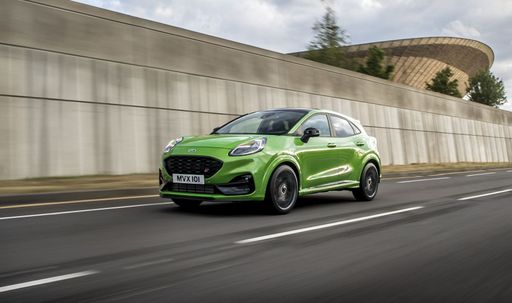
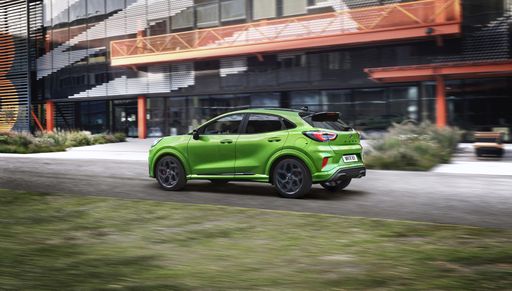
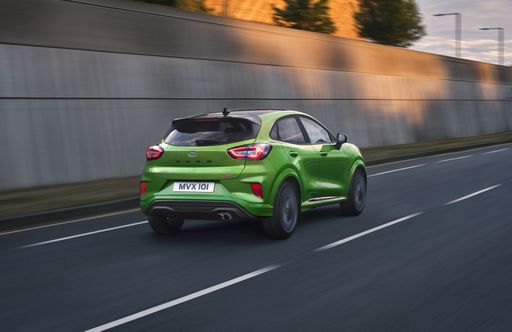
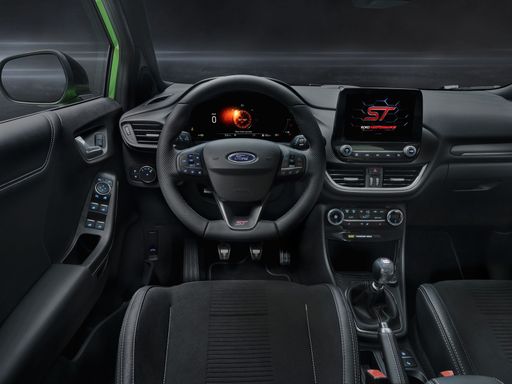
@ Ford Motor Company / Ford Media Center
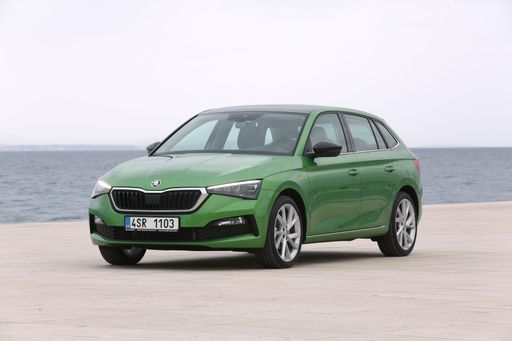
@ Škoda Auto a.s. / Škoda Storyboard
VS

Ford Puma vs Skoda Scala – Which model is better for everyday use?

Compare performance, boot capacity, efficiency and price at a glance.
Find out which car is the better choice for you – Ford Puma or Skoda Scala?

Puma @ Ford Motor Company / Ford Media Center

Ford Puma vs Skoda Scala: Battle of the Compacts

In the ever-evolving world of automotive excellence, compact cars remain an enduring favorite for city dwellers and small families. The Ford Puma and Skoda Scala are two standout offerings in this category, each bringing unique features and innovations to the table. Let's delve into a detailed comparison that weighs their technical aspects and what makes them stand out in the urban jungle.

Scala @ Škoda Auto a.s. / Škoda Storyboard

Design and Body Type

The Ford Puma, characterized as an SUV, presents a bold and sporty profile with a height ranging between 1550 to 1555 mm and a width of 1805 mm. At lengths between 4186 to 4226 mm, the Puma offers a sleek yet spacious design.

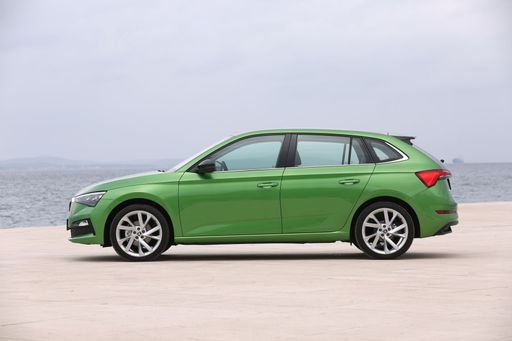
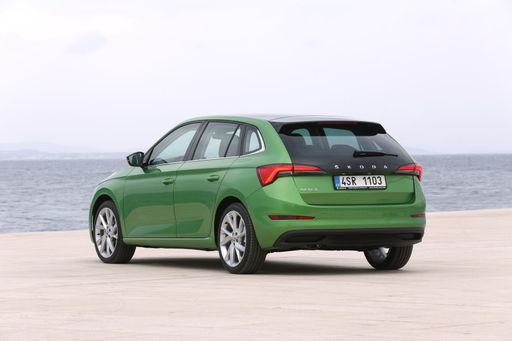
On the other hand, the Skoda Scala flaunts a quintessential hatchback style. Measuring 4362 mm in length, 1793 mm in width, and 1514 mm in height, the Scala offers more of a classic, elongated silhouette ideal for both city maneuverability and longer drives.

Puma @ Ford Motor Company / Ford Media Center

Engine and Transmission Options

Under the hood, the Ford Puma offers a choice between a Mild Hybrid Electric Vehicle (MHEV) and a fully electric variant, with power outputs from 125 to 168 HP. The engines are supported by either a manual gearbox, a dual-clutch automatic, or a reduction gearbox for the electric version. This setup offers drivers remarkable flexibility in how they want their driving experience to unfold, supplemented by a front-wheel-drive system.

The Skoda Scala's petrol engine options range from 95 to 150 HP and are available with either a manual or a dual-clutch automatic transmission. It remains firmly in the front-wheel drive camp as well, managing to balance efficiency and performance successfully.

Scala @ Škoda Auto a.s. / Škoda Storyboard

Performance and Efficiency

Ford Puma's engines promise an impressive blend of performance and eco-conscious driving. It boasts a fuel consumption range between 5.4 to 6 L/100km, while the electric variant consumes 13.1 to 13.7 kWh/100km, with a capable electric range of up to 376 km.

Skoda Scala, meanwhile, promises economical petrol consumption between 5.1 to 5.6 L/100km. With its top speed reaching up to 221 km/h, the Scala caters well to those looking for a slightly racier feel in a compact package.

Puma @ Ford Motor Company / Ford Media Center

Interior Comfort and Capacity

Both the Puma and the Scala accommodate five passengers comfortably. The Puma offers a trunk capacity between 456 to 523 liters, potentially making it more versatile for carrying equipment, groceries, or luggage. The Scala stands strong with a 467-liter trunk capacity, balancing utility and comfort effortlessly.

Scala @ Škoda Auto a.s. / Škoda Storyboard

Technological Innovations

Ford has integrated its SUV with the latest infotainment systems, featuring seamless smartphone connectivity and advanced safety technologies. The Puma provides a connected and safe drive with various driver-assistance systems.

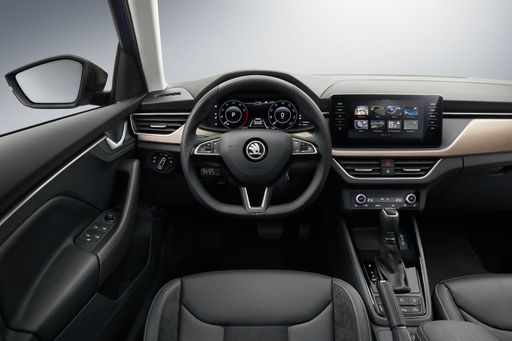
Skoda Scala does not lag behind in tech features. It offers a high-definition infotainment system with excellent connectivity, ensuring drivers and passengers have a modern motoring experience with all essential conveniences at their fingertips.

Puma @ Ford Motor Company / Ford Media Center

Final Thoughts

In this compact car comparison, both the Ford Puma and Skoda Scala bring a host of impressive features and capabilities to the table. Whether it’s the sporty, flexible drive offered by the Puma or the pragmatic and versatile Scala, potential buyers must weigh their city-driving needs, performance desires, and preference for body style when making a choice.

Ultimately, whether you're choosing the electrified and adventurous route with the Puma or a classic and efficient journey with the Scala, both cars promise to push the boundaries of what compact vehicles can achieve.

Here’s where it gets real: The technical differences in detail

Scala @ Škoda Auto a.s. / Škoda Storyboard

Costs and Efficiency:

Looking at overall running costs, both models reveal some interesting differences in everyday economy.

Skoda Scala has a a bit advantage in terms of price – it starts at 20900 £, while the Ford Puma costs 24800 £. That’s a price difference of around 3866 £.

Fuel consumption also shows a difference: Skoda Scala manages with 5 L and is therefore barely noticeable more efficient than the Ford Puma with 5.40 L. The difference is about 0.40 L per 100 km.

Engine and Performance:

Under the bonnet, it becomes clear which model is tuned for sportiness and which one takes the lead when you hit the accelerator.

When it comes to engine power, the Ford Puma has a somewhat edge – offering 168 HP compared to 150 HP. That’s roughly 18 HP more horsepower.

In acceleration from 0 to 100 km/h, the Ford Puma is somewhat quicker – completing the sprint in 7.40 s, while the Skoda Scala takes 8.20 s. That’s about 0.80 s faster.

In terms of top speed, the Skoda Scala performs minimal better – reaching 221 km/h, while the Ford Puma tops out at 210 km/h. The difference is around 11 km/h.

There’s also a difference in torque: Ford Puma pulls slightly stronger with 290 Nm compared to 250 Nm. That’s about 40 Nm difference.

Space and Everyday Use:

Whether family car or daily driver – which one offers more room, flexibility and comfort?

Both vehicles offer seating for 5 people.

In curb weight, Skoda Scala is hardly perceptible lighter – 1199 kg compared to 1316 kg. The difference is around 117 kg.

In terms of boot space, the Ford Puma offers to a small extent more room – 523 L compared to 467 L. That’s a difference of about 56 L.

In maximum load capacity, the Skoda Scala performs barely noticeable better – up to 1410 L, which is about 127 L more than the Ford Puma.

When it comes to payload, Ford Puma barely noticeable takes the win – 469 kg compared to 431 kg. That’s a difference of about 38 kg.

Who wins the race?

The Skoda Scala proves to be performs better in key areas and therefore becomes our DriveDuel Champion!
Skoda Scala is the better all-rounder in this comparison.

from about £20,900
Scala @ Škoda Auto a.s. / Škoda Storyboard

Skoda Scala

  • Engine Type : Petrol
  • Transmission : Manuel, Automatic
  • Drive Type : Front-Wheel Drive
  • Power HP : 95 - 150 HP
  • Consumption L/100km : 5 - 5.6 L

Ford Puma

5 (1)
rate

The Ford Puma is a cheeky compact crossover that blends sporty styling with city-friendly practicality, giving drivers a surprisingly fun and composed ride. With clever storage tricks and a lively personality, it’s a smart pick for buyers who want enjoyment without fuss.

details

Skoda Scala

5 (2)
rate

The Skoda Scala is a tidy, no-nonsense hatch that wraps clever packaging and composed manners into a compact, grown-up package. It’s the sensible choice for buyers who want everyday practicality with a dash of style and personality—no drama, just reliable charm.

details
Ford Puma
Skoda Scala
Puma @ Ford Motor Company / Ford Media Center
Scala @ Škoda Auto a.s. / Škoda Storyboard

Costs and Consumption

Price
24800 - 36300 £
Price
20900 - 30700 £
Consumption L/100km
5.4 - 5.9 L
Consumption L/100km
5 - 5.6 L
Consumption kWh/100km
13.1 - 13.9 kWh
Consumption kWh/100km
-
Electric Range
361 - 376 km
Electric Range
-
Battery Capacity
43 kWh
Battery Capacity
-
co2
0 - 135 g/km
co2
114 - 126 g/km
Fuel tank capacity
42 L
Fuel tank capacity
50 L

Dimensions and Body

Body Type
SUV
Body Type
Hatchback
Seats
5
Seats
5
Doors
5
Doors
5
Curb weight
1316 - 1563 kg
Curb weight
1199 - 1271 kg
Trunk capacity
456 - 523 L
Trunk capacity
467 L
Length
4186 - 4226 mm
Length
4362 mm
Width
1805 mm
Width
1793 mm
Height
1550 - 1555 mm
Height
1514 mm
Max trunk capacity
1216 - 1283 L
Max trunk capacity
1410 L
Payload
367 - 469 kg
Payload
403 - 431 kg

Engine and Performance

Engine Type
Electric, Petrol MHEV
Engine Type
Petrol
Transmission
Automatic, Manuel
Transmission
Manuel, Automatic
Transmission Detail
Reduction Gearbox, Manual Gearbox, Dual-Clutch Automatic
Transmission Detail
Manual Gearbox, Dual-Clutch Automatic
Drive Type
Front-Wheel Drive
Drive Type
Front-Wheel Drive
Power HP
125 - 168 HP
Power HP
95 - 150 HP
Acceleration 0-100km/h
7.4 - 9.8 s
Acceleration 0-100km/h
8.2 - 10.8 s
Max Speed
160 - 210 km/h
Max Speed
192 - 221 km/h
Torque
170 - 290 Nm
Torque
175 - 250 Nm
Number of Cylinders
3
Number of Cylinders
3 - 4
Power kW
92 - 124 kW
Power kW
70 - 110 kW
Engine capacity
999 cm3
Engine capacity
999 - 1498 cm3

General

Model Year
2025
Model Year
2025
CO2 Efficiency Class
A, D
CO2 Efficiency Class
C, D
Brand
Ford
Brand
Skoda
Is the Ford Puma offered with different drivetrains?

The Ford Puma is offered with Front-Wheel Drive.

The prices and data displayed are estimates based on German list prices and may vary by country. This information is not legally binding.