@ Ford Motor Company / Ford Media Center
VS

Ford Puma vs Nissan Micra – Which one offers the better deal?

Everyday use, family trips or long-distance drives – here’s where the differences show.
Discover whether Ford Puma or Nissan Micra fits your lifestyle better.

Here’s where it gets real: The technical differences in detail

Puma @ Ford Motor Company / Ford Media Center

Costs and Efficiency:

Looking at overall running costs, both models reveal some interesting differences in everyday economy.

Nissan Micra has a barely noticeable advantage in terms of price – it starts at 24000 £, while the Ford Puma costs 24800 £. That’s a price difference of around 780 £.

In terms of energy consumption, the advantage goes to the Ford Puma: with 13.10 kWh per 100 km, it’s barely noticeable more efficient than the Nissan Micra with 14.20 kWh. That’s a difference of about 1.10 kWh.

As for range, the Nissan Micra performs hardly perceptible better – achieving up to 416 km, about 40 km more than the Ford Puma.

Puma @ Ford Motor Company / Ford Media Center

Engine and Performance:

Power, torque and acceleration are the classic benchmarks for car enthusiasts – and here, some clear differences start to show.

When it comes to engine power, the Ford Puma has a slightly edge – offering 168 HP compared to 150 HP. That’s roughly 18 HP more horsepower.

In acceleration from 0 to 100 km/h, the Ford Puma is hardly perceptible quicker – completing the sprint in 7.40 s, while the Nissan Micra takes 8 s. That’s about 0.60 s faster.

In terms of top speed, the Ford Puma performs distinct better – reaching 210 km/h, while the Nissan Micra tops out at 150 km/h. The difference is around 60 km/h.

There’s also a difference in torque: Ford Puma pulls somewhat stronger with 290 Nm compared to 245 Nm. That’s about 45 Nm difference.

Puma @ Ford Motor Company / Ford Media Center

Space and Everyday Use:

Whether family car or daily driver – which one offers more room, flexibility and comfort?

Both vehicles offer seating for 5 people.

In curb weight, Ford Puma is a bit lighter – 1316 kg compared to 1452 kg. The difference is around 136 kg.

In terms of boot space, the Ford Puma offers distinct more room – 523 L compared to 326 L. That’s a difference of about 197 L.

In maximum load capacity, the Ford Puma performs somewhat better – up to 1283 L, which is about 177 L more than the Nissan Micra.

When it comes to payload, Ford Puma slightly takes the win – 469 kg compared to 408 kg. That’s a difference of about 61 kg.

Who wins the race?

The Ford Puma proves to be leaves the rival little chance and therefore becomes our DriveDuel Champion!
Ford Puma is the better all-rounder in this comparison.

from about £24,800
Puma @ Ford Motor Company / Ford Media Center

Ford Puma

  • Engine Type : Electric, Petrol MHEV
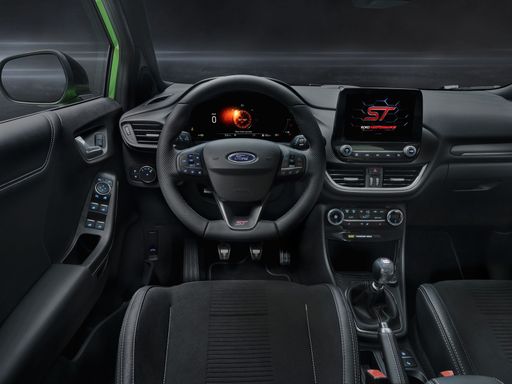
  • Transmission : Automatic, Manuel
  • Drive Type : Front-Wheel Drive
  • Power HP : 125 - 168 HP
  • Consumption L/100km : 5.4 - 5.9 L
  • Consumption kWh/100km : 13.1 - 13.9 kWh
  • Electric Range : 361 - 376 km

Ford Puma

5 (1)
rate

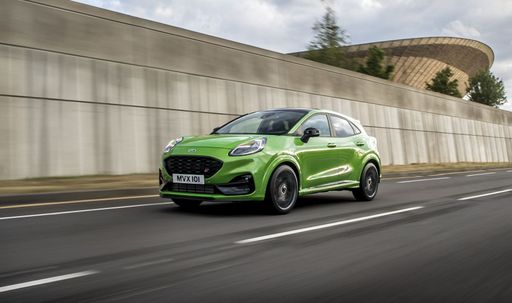
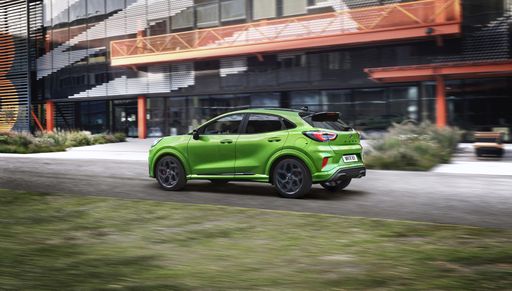
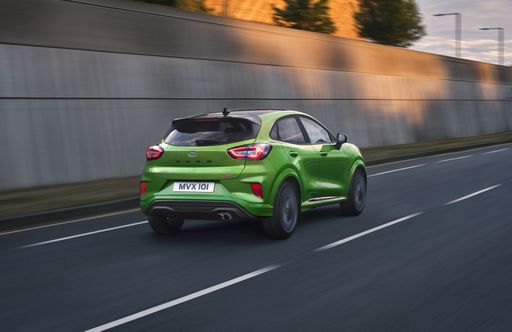
The Ford Puma is a cheeky compact crossover that blends sporty styling with city-friendly practicality, giving drivers a surprisingly fun and composed ride. With clever storage tricks and a lively personality, it’s a smart pick for buyers who want enjoyment without fuss.

details

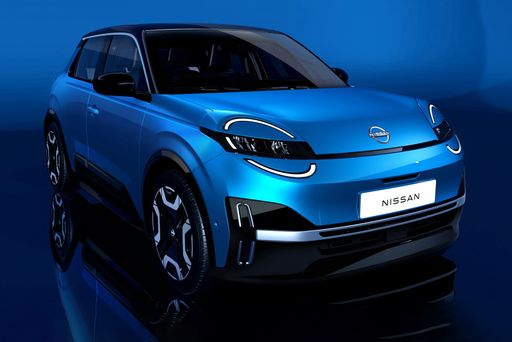
Nissan Micra

The Nissan Micra is a compact hatchback renowned for its agile handling and city-friendly dimensions. With a design that blends sleek curves with a practical layout, it appeals to urban drivers who value style and efficiency. Inside, the car offers a surprising amount of room and useful tech features, making it both a convenient and comfortable ride for daily commutes.

details
Ford Puma
Nissan Micra
Puma @ Ford Motor Company / Ford Media Center

Costs and Consumption

Price
24800 - 36300 £
Price
24000 - 29900 £
Consumption L/100km
5.4 - 5.9 L
Consumption L/100km
-
Consumption kWh/100km
13.1 - 13.9 kWh
Consumption kWh/100km
14.2 - 14.7 kWh
Electric Range
361 - 376 km
Electric Range
317 - 416 km
Battery Capacity
43 kWh
Battery Capacity
40 - 52 kWh
co2
0 - 135 g/km
co2
0 g/km
Fuel tank capacity
42 L
Fuel tank capacity
-

Dimensions and Body

Body Type
SUV
Body Type
Hatchback
Seats
5
Seats
5
Doors
5
Doors
5
Curb weight
1316 - 1563 kg
Curb weight
1452 - 1527 kg
Trunk capacity
456 - 523 L
Trunk capacity
326 L
Length
4186 - 4226 mm
Length
3974 mm
Width
1805 mm
Width
1774 mm
Height
1550 - 1555 mm
Height
1490 mm
Max trunk capacity
1216 - 1283 L
Max trunk capacity
1106 L
Payload
367 - 469 kg
Payload
403 - 408 kg

Engine and Performance

Engine Type
Electric, Petrol MHEV
Engine Type
Electric
Transmission
Automatic, Manuel
Transmission
Automatic
Transmission Detail
Reduction Gearbox, Manual Gearbox, Dual-Clutch Automatic
Transmission Detail
Reduction Gearbox
Drive Type
Front-Wheel Drive
Drive Type
Front-Wheel Drive
Power HP
125 - 168 HP
Power HP
122 - 150 HP
Acceleration 0-100km/h
7.4 - 9.8 s
Acceleration 0-100km/h
8 - 9 s
Max Speed
160 - 210 km/h
Max Speed
150 km/h
Torque
170 - 290 Nm
Torque
225 - 245 Nm
Number of Cylinders
3
Number of Cylinders
-
Power kW
92 - 124 kW
Power kW
90 - 110 kW
Engine capacity
999 cm3
Engine capacity
-

General

Model Year
2025
Model Year
2026
CO2 Efficiency Class
A, D
CO2 Efficiency Class
A
Brand
Ford
Brand
Nissan
Is the Ford Puma offered with different drivetrains?

The Ford Puma is offered with Front-Wheel Drive.

The prices and data displayed are estimates based on German list prices and may vary by country. This information is not legally binding.