
 Deutschland
 France
 Nederland
 Great Britain
 Sverige
 Norge
Norge Danmark
 Suomi
Suomi Italia
 Polska
 España
VS
Jeep Avenger vs Alpine A390 - Differences and prices compared
Avenger
@ Jeep / Stellantis Media
Costs and Efficiency:
Price and efficiency are often the first things buyers look at. Here it becomes clear which model has the long-term edge – whether at the pump, the plug, or in purchase price.
Jeep Avenger has a clearly advantage in terms of price – it starts at 21900 £, while the Alpine A390 costs 57900 £. That’s a price difference of around 35915 £.
In terms of energy consumption, the advantage goes to the Jeep Avenger: with 15.50 kWh per 100 km, it’s distinct more efficient than the Alpine A390 with 18.70 kWh. That’s a difference of about 3.20 kWh.
As for range, the Alpine A390 performs noticeable better – achieving up to 555 km, about 155 km more than the Jeep Avenger.
Avenger
@ Jeep / Stellantis Media
Engine and Performance:
Power, torque and acceleration say a lot about how a car feels on the road. This is where you see which model delivers more driving dynamics.
When it comes to engine power, the Alpine A390 has a convincingly edge – offering 470 HP compared to 156 HP. That’s roughly 314 HP more horsepower.
In acceleration from 0 to 100 km/h, the Alpine A390 is clearly quicker – completing the sprint in 3.90 s, while the Jeep Avenger takes 9 s. That’s about 5.10 s faster.
In terms of top speed, the Alpine A390 performs somewhat better – reaching 220 km/h, while the Jeep Avenger tops out at 194 km/h. The difference is around 26 km/h.
There’s also a difference in torque: Alpine A390 pulls clearly stronger with 824 Nm compared to 260 Nm. That’s about 564 Nm difference.
Avenger
@ Jeep / Stellantis Media
Space and Everyday Use:
Cabin size, boot volume and payload all play a role in everyday practicality. Here, comfort and flexibility make the difference.
Seats: offers more seating capacity – vs .
In curb weight, Jeep Avenger is significantly lighter – 1180 kg compared to 2121 kg. The difference is around 941 kg.
In terms of boot space, the Alpine A390 offers noticeable more room – 532 L compared to 380 L. That’s a difference of about 152 L.
In maximum load capacity, the Alpine A390 performs clearly perceptible better – up to 1643 L, which is about 366 L more than the Jeep Avenger.
Who wins the race?
The Alpine A390 proves to be is largely superior and therefore becomes our DriveDuel Champion!
Alpine A390 is the better all-rounder in this comparison.
from about £57,900

Alpine A390
Jeep Avenger
Alpine A390
Costs and Consumption
View detailed analysis
View detailed analysis
Engine and Performance
View detailed analysis
View detailed analysis
Dimensions and Body
View detailed analysis
View detailed analysis
Jeep Avenger
5 (2 Reviews)
The Jeep Avenger shrinks Jeep's boxy, adventurous styling into a city-friendly electric crossover that looks just as at home on tight streets as it does on muddy weekend lanes. It's a savvy pick for drivers who want go-anywhere attitude without the truck-size ego — practical inside, lively around town and ready to tackle a bit of rough stuff when the mood strikes.
details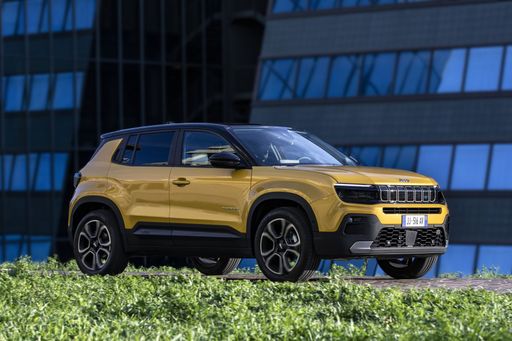 @ Jeep / Stellantis Media
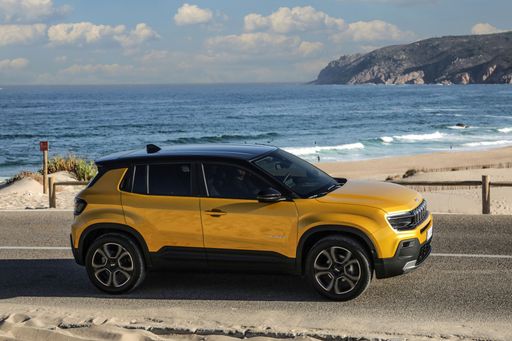 @ Jeep / Stellantis Media
 @ Jeep / Stellantis Media
 @ Jeep / Stellantis Media
 @ Jeep / Stellantis Media
Alpine A390
The Alpine A390 is the brand’s leap into the fast electric crossover arena, wrapping Dieppe’s lightweight ethos in a sleek, coupe-ish body with real everyday usability. If the steering and chassis feel echo the A110, this could be the enthusiast’s family EV—subtle, sharp, and très chic, with enough theatre to make the school run feel like a pit lane exit.
details
Jeep Avenger
Alpine A390
|
@ Jeep / Stellantis Media
|
|
|
|
|
Costs and Consumption |
|
|---|---|
|
Price
21900 - 36900 £
|
Price
57900 - 66900 £
|
|
Consumption L/100km
4.9 - 5.7 L
|
Consumption L/100km
-
|
|
Consumption kWh/100km
15.50 kWh
|
Consumption kWh/100km
18.7 - 19.8 kWh
|
|
Electric Range
400 km
|
Electric Range
515 - 555 km
|
|
Battery Capacity
51 kWh
|
Battery Capacity
89 kWh
|
|
co2
0 - 129 g/km
|
co2
0 g/km
|
|
Fuel tank capacity
44 L
|
Fuel tank capacity
-
|
Dimensions and Body |
|
|---|---|
|
Body Type
SUV
|
Body Type
SUV
|
|
Seats
5
|
Seats
5
|
|
Doors
5
|
Doors
5
|
|
Curb weight
1180 - 1520 kg
|
Curb weight
2121 kg
|
|
Trunk capacity
325 - 380 L
|
Trunk capacity
532 L
|
|
Length
4084 - 4088 mm
|
Length
4615 mm
|
|
Width
1776 mm
|
Width
1885 mm
|
|
Height
1527 - 1541 mm
|
Height
1532 mm
|
|
Max trunk capacity
1218 - 1277 L
|
Max trunk capacity
1643 L
|
|
Payload
494 - 502 kg
|
Payload
-
|
Engine and Performance |
|
|---|---|
|
Engine Type
Electric, Petrol, Petrol MHEV
|
Engine Type
Electric
|
|
Transmission
Automatic, Manuel
|
Transmission
Automatic
|
|
Transmission Detail
Reduction Gearbox, Manual Gearbox, Dual-Clutch Automatic
|
Transmission Detail
Reduction Gearbox
|
|
Drive Type
Front-Wheel Drive, All-Wheel Drive
|
Drive Type
All-Wheel Drive
|
|
Power HP
100 - 156 HP
|
Power HP
400 - 470 HP
|
|
Acceleration 0-100km/h
9 - 10.6 s
|
Acceleration 0-100km/h
3.9 - 4.8 s
|
|
Max Speed
150 - 194 km/h
|
Max Speed
200 - 220 km/h
|
|
Torque
205 - 260 Nm
|
Torque
661 - 824 Nm
|
|
Number of Cylinders
3
|
Number of Cylinders
-
|
|
Power kW
74 - 115 kW
|
Power kW
295 - 345 kW
|
|
Engine capacity
1199 cm3
|
Engine capacity
-
|
General |
|
|---|---|
|
Model Year
2023 - 2025
|
Model Year
2026
|
|
CO2 Efficiency Class
A, D, C
|
CO2 Efficiency Class
A
|
|
Brand
Jeep
|
Brand
Alpine
|
What drivetrain options does the Jeep Avenger have?
Available configurations include Front-Wheel Drive or All-Wheel Drive.
The prices and data displayed are estimates based on German list prices and may vary by country. This information is not legally binding.