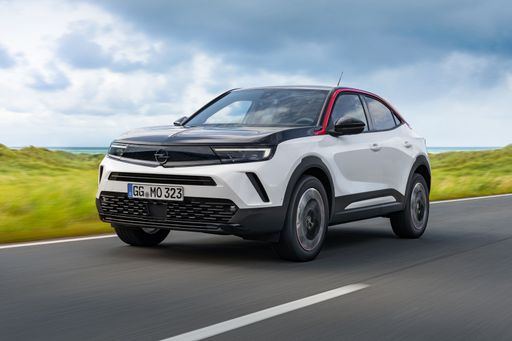
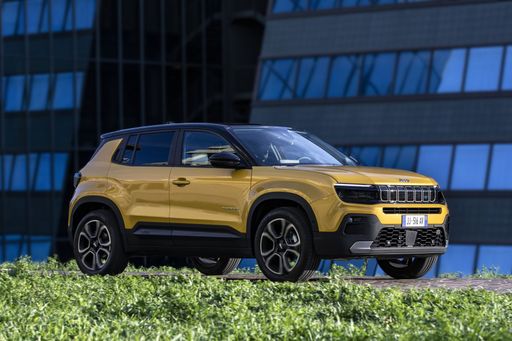
Compare performance (156 HP vs 281 HP), boot space and price (21900 £ vs 23000 £ ) at a glance. Find out which car is the better choice for you – Jeep Avenger or Vauxhall Mokka?
Price and efficiency are key factors when choosing a car – and this is often where the real differences emerge.
Jeep Avenger has a minimal advantage in terms of price – it starts at 21900 £ , while the Vauxhall Mokka costs 23000 £ . That’s a price difference of around 1106 £.
Both cars consume an average of 4.90 L per 100 km – no difference here.
In terms of energy consumption, the advantage goes to the Vauxhall Mokka: with 15.40 kWh per 100 km, it’s barely noticeable more efficient than the Jeep Avenger with 15.50 kWh. That’s a difference of about 0.10 kWh.
As for electric range, the Vauxhall Mokka performs hardly perceptible better – achieving up to 403 km, about 3 km more than the Jeep Avenger.
Power, torque and acceleration say a lot about how a car feels on the road. This is where you see which model delivers more driving dynamics.
When it comes to engine power, the Vauxhall Mokka has a decisively edge – offering 281 HP compared to 156 HP. That’s roughly 125 HP more horsepower.
In acceleration from 0 to 100 km/h, the Vauxhall Mokka is convincingly quicker – completing the sprint in 5.90 s, while the Jeep Avenger takes 9 s. That’s about 3.10 s faster.
In terms of top speed, the Vauxhall Mokka performs barely noticeable better – reaching 209 km/h, while the Jeep Avenger tops out at 194 km/h. The difference is around 15 km/h.
There’s also a difference in torque: Vauxhall Mokka pulls distinct stronger with 345 Nm compared to 260 Nm. That’s about 85 Nm difference.
Cabin size, boot volume and payload all play a role in everyday practicality. Here, comfort and flexibility make the difference.
Both vehicles offer seating for 5 people.
In curb weight, Jeep Avenger is minimal lighter – 1180 kg compared to 1294 kg. The difference is around 114 kg.
In terms of boot space, the Jeep Avenger offers hardly perceptible more room – 380 L compared to 350 L. That’s a difference of about 30 L.
In maximum load capacity, the Jeep Avenger performs a bit better – up to 1277 L, which is about 172 L more than the Vauxhall Mokka.
When it comes to payload, Jeep Avenger noticeable takes the win – 502 kg compared to 400 kg. That’s a difference of about 102 kg.
The Vauxhall Mokka is decisively ahead in the objective data comparison.
This result only shows which model scores more points on paper – not which of the two cars feels right for you.
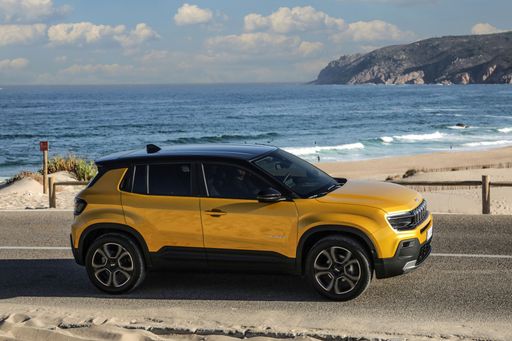
The Jeep Avenger shrinks Jeep's boxy, adventurous styling into a city-friendly electric crossover that looks just as at home on tight streets as it does on muddy weekend lanes. It's a savvy pick for drivers who want go-anywhere attitude without the truck-size ego — practical inside, lively around town and ready to tackle a bit of rough stuff when the mood strikes.
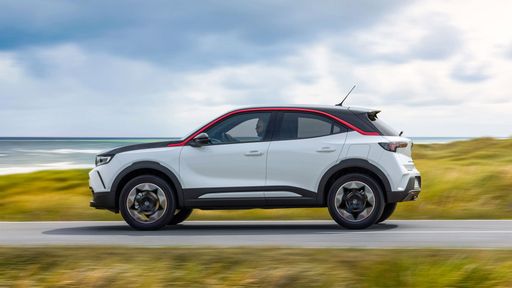
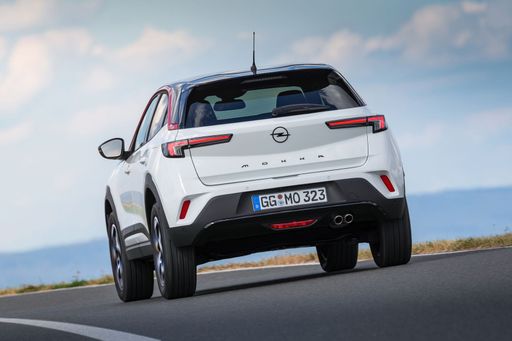
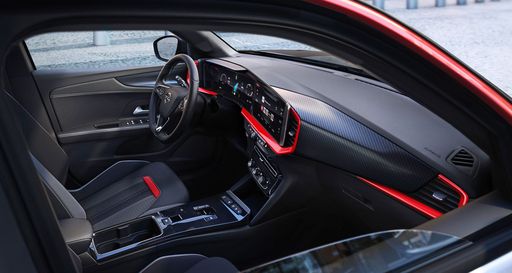
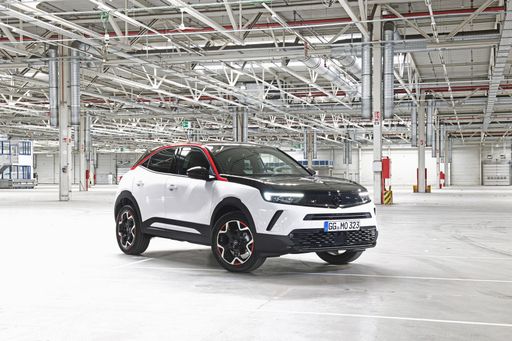
detailsThe Opel Mokka cuts a smart, modern silhouette that feels right at home in the city while still turning heads on the open road. It's a practical, easy-to-live-with crossover that blends comfy driving manners with enough flair and tech to keep daily commutes interesting — and it won’t make you regret trading up.
detailsCosts and Consumption |
|
|---|---|
|
Price
21900 - 36900 £
|
Price
23000 - 40500 £
|
|
Consumption L/100km
4.9 - 5.7 L
|
Consumption L/100km
4.9 - 5.7 L
|
|
Consumption kWh/100km
15.50 kWh
|
Consumption kWh/100km
15.4 - 18.5 kWh
|
|
Electric Range
400 km
|
Electric Range
336 - 403 km
|
|
Battery Capacity
51 kWh
|
Battery Capacity
51 kWh
|
|
co2
0 - 129 g/km
|
co2
0 - 129 g/km
|
|
Fuel tank capacity
44 L
|
Fuel tank capacity
44 L
|
Dimensions and Body |
|
|---|---|
|
Body Type
SUV
|
Body Type
SUV
|
|
Seats
5
|
Seats
5
|
|
Doors
5
|
Doors
5
|
|
Curb weight
1180 - 1520 kg
|
Curb weight
1294 - 1672 kg
|
|
Trunk capacity
325 - 380 L
|
Trunk capacity
310 - 350 L
|
|
Length
4084 - 4088 mm
|
Length
4150 mm
|
|
Width
1776 mm
|
Width
1787 mm
|
|
Height
1527 - 1541 mm
|
Height
1506 - 1535 mm
|
|
Max trunk capacity
1218 - 1277 L
|
Max trunk capacity
1060 - 1105 L
|
|
Payload
494 - 502 kg
|
Payload
388 - 400 kg
|
Engine and Performance |
|
|---|---|
|
Engine Type
Electric, Petrol, Petrol MHEV
|
Engine Type
Electric, Petrol MHEV, Petrol
|
|
Transmission
Automatic, Manuel
|
Transmission
Automatic, Manuel
|
|
Transmission Detail
Reduction Gearbox, Manual Gearbox, Dual-Clutch Automatic
|
Transmission Detail
Reduction Gearbox, Dual-Clutch Automatic, Manual Gearbox
|
|
Drive Type
Front-Wheel Drive, All-Wheel Drive
|
Drive Type
Front-Wheel Drive
|
|
Power HP
100 - 156 HP
|
Power HP
136 - 281 HP
|
|
Acceleration 0-100km/h
9 - 10.6 s
|
Acceleration 0-100km/h
5.9 - 9 s
|
|
Max Speed
150 - 194 km/h
|
Max Speed
150 - 209 km/h
|
|
Torque
205 - 260 Nm
|
Torque
230 - 345 Nm
|
|
Number of Cylinders
3
|
Number of Cylinders
3
|
|
Power kW
74 - 115 kW
|
Power kW
100 - 207 kW
|
|
Engine capacity
1199 cm3
|
Engine capacity
1199 cm3
|
General |
|
|---|---|
|
Model Year
2023 - 2025
|
Model Year
2024 - 2025
|
|
CO2 Efficiency Class
A, D, C
|
CO2 Efficiency Class
A, C, D
|
|
Brand
Jeep
|
Brand
Vauxhall
|
Available configurations include Front-Wheel Drive or All-Wheel Drive.