@ Alfa Romeo / Stellantis Media
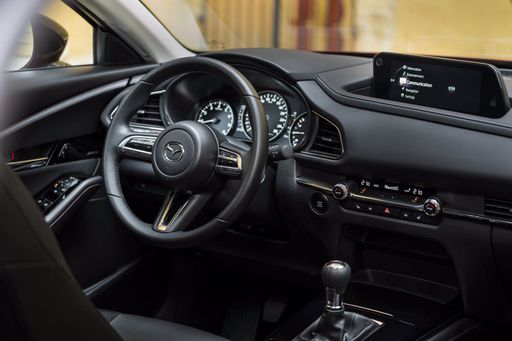
@ Mazda Motor Corporation
VS

Alfa Romeo Junior vs Mazda CX-30 – Differences & prices compared

Everyday use, family trips or long-distance drives – here’s where the differences show.
Discover whether Alfa Romeo Junior or Mazda CX-30 fits your lifestyle better.

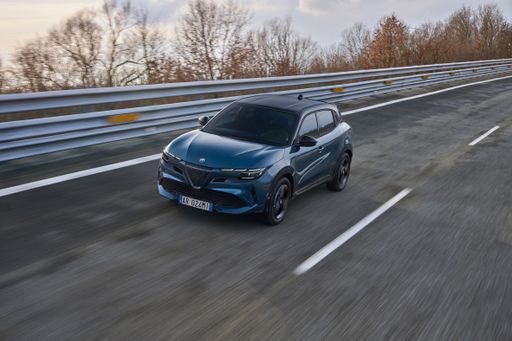
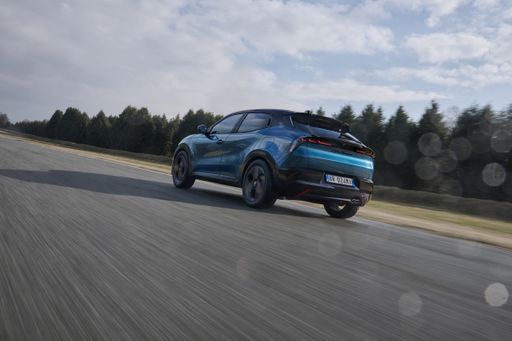
Junior @ Alfa Romeo / Stellantis Media

Alfa Romeo Junior vs. Mazda CX-30: A Clash of Compact SUV Titans

In the world of compact SUVs, the competition is fierce, and the Alfa Romeo Junior and Mazda CX-30 are two formidable contenders that offer an intriguing mix of performance, innovation, and style. Both vehicles bring their A-game, but how do they stack up against each other? Let’s delve into the technical details and innovations that set these models apart.
CX-30 @ Mazda Motor Corporation

Engineering Excellence: Under the Hood

The Alfa Romeo Junior offers a diverse range of engine choices, including electric and petrol Mild Hybrid Electric Vehicle (MHEV) options. With power outputs ranging from 136 to 280 HP, it caters to various performance preferences. The electric variant promises an impressive range of up to 410 kilometers on a single charge, thanks to its 51 kWh battery capacity.

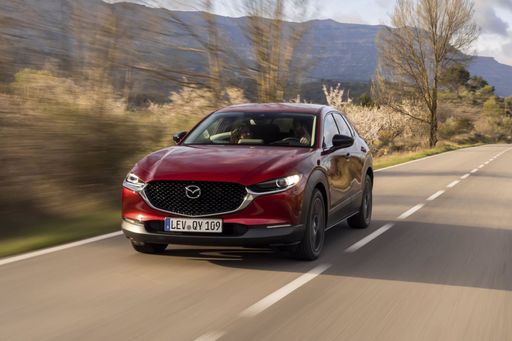
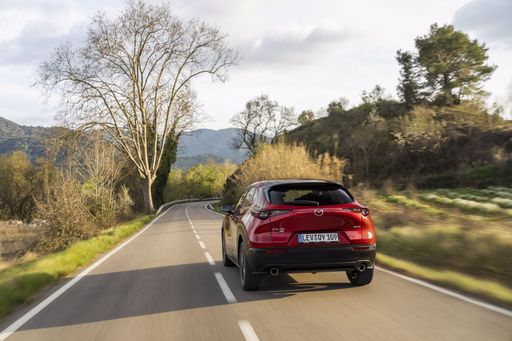
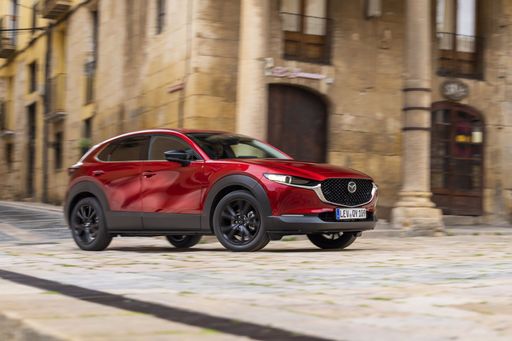
On the other hand, the Mazda CX-30 sticks with a more conventional approach, offering petrol MHEV engines that deliver between 140 and 186 HP. Its power and efficiency are evident, with fuel consumption as low as 5.7 L/100km, presenting a compelling option for those inclined towards traditional combustion engines.

Junior @ Alfa Romeo / Stellantis Media

Transmission and Drive Dynamics

Alfa Romeo provides both front-wheel drive and all-wheel drive options, paired with advanced transmission systems. The Junior features a reduction gearbox for its electric version and a dual-clutch automatic for the petrol variants, ensuring seamless power delivery and responsive handling.

Mazda's CX-30 offers the choice of manual and automatic gearboxes, tailored for front-wheel and all-wheel drive configurations. Its manual gearbox option might appeal to driving enthusiasts who value a more engaging driving experience.

CX-30 @ Mazda Motor Corporation

Performance and Efficiency

When it comes to acceleration, the Alfa Romeo Junior stands out, with its fastest variant reaching 0-100 km/h in just 5.9 seconds. Meanwhile, the CX-30's best time is 8.3 seconds, which, while less thrilling, aligns with its focus on balanced performance and economy.

The eco-conscious will appreciate the Junior's electric variant, which boasts a CO2 efficiency class of 'A' with zero emissions. The petrol variants have varying levels of emissions, but the most efficient offers a commendable 4.5 L/100km consumption. The CX-30, despite its petrol-only lineup, maintains respectable CO2 efficiency levels, though not as low as the electric Alfa Romeo.

Junior @ Alfa Romeo / Stellantis Media

Interior Space and Comfort

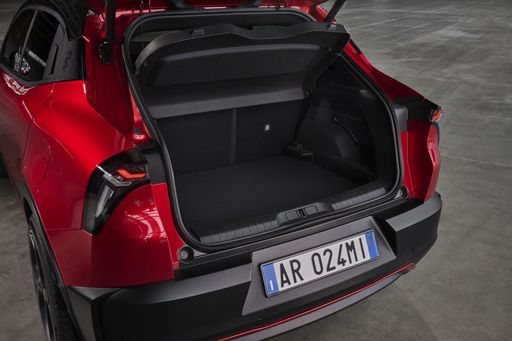
Both models comfortably seat five passengers, but there are differences in their trunk capacities. The CX-30 offers a slightly larger trunk capacity at 430 liters, compared to the Junior's maximum of 415 liters, making it a potentially better choice for those who prioritize cargo space.

Regarding dimensions, the Mazda CX-30 is longer and wider, measuring 4395 mm in length and 1795 mm in width. In contrast, the Junior is more compact, measuring 4173 mm in length and 1781 mm in width, which could be advantageous for urban driving and parking.

CX-30 @ Mazda Motor Corporation

Final Verdict

The Alfa Romeo Junior and Mazda CX-30 each have their unique strengths. The Junior's electric innovation and faster acceleration would appeal to those seeking cutting-edge technology and performance. The CX-30, with its slightly larger size and traditional petrol engine, continues to charm with its practicality and reliability.

Ultimately, the choice between the Alfa Romeo Junior and Mazda CX-30 depends on individual priorities—be it technological innovation and efficiency or tried-and-true performance and space. Both models demonstrate that the compact SUV segment is alive with innovation and style, offering something for every type of driver.

Here’s where it gets real: The technical differences in detail

Costs and Efficiency:

When it comes to price and running costs, the biggest differences usually appear. This is often where you see which car fits your budget better in the long run.

Mazda CX-30 has a barely noticeable advantage in terms of price – it starts at 25200 £, while the Alfa Romeo Junior costs 26100 £. That’s a price difference of around 866 £.

Fuel consumption also shows a difference: Alfa Romeo Junior manages with 4.80 L and is therefore to a small extent more efficient than the Mazda CX-30 with 5.70 L. The difference is about 0.90 L per 100 km.

Engine and Performance:

Power, torque and acceleration say a lot about how a car feels on the road. This is where you see which model delivers more driving dynamics.

When it comes to engine power, the Alfa Romeo Junior has a distinct edge – offering 280 HP compared to 186 HP. That’s roughly 94 HP more horsepower.

In acceleration from 0 to 100 km/h, the Alfa Romeo Junior is clearly quicker – completing the sprint in 5.90 s, while the Mazda CX-30 takes 8.30 s. That’s about 2.40 s faster.

In terms of top speed, the Alfa Romeo Junior performs barely noticeable better – reaching 206 km/h, while the Mazda CX-30 tops out at 204 km/h. The difference is around 2 km/h.

There’s also a difference in torque: Alfa Romeo Junior pulls distinct stronger with 345 Nm compared to 240 Nm. That’s about 105 Nm difference.

Space and Everyday Use:

Cabin size, boot volume and payload all play a role in everyday practicality. Here, comfort and flexibility make the difference.

Both vehicles offer seating for 5 people.

In curb weight, Alfa Romeo Junior is barely noticeable lighter – 1380 kg compared to 1455 kg. The difference is around 75 kg.

In terms of boot space, the Mazda CX-30 offers slight more room – 430 L compared to 415 L. That’s a difference of about 15 L.

In maximum load capacity, the Mazda CX-30 performs minimal better – up to 1406 L, which is about 126 L more than the Alfa Romeo Junior.

When it comes to payload, Mazda CX-30 slightly takes the win – 496 kg compared to 420 kg. That’s a difference of about 76 kg.

Who comes out on top?

Overall, the Alfa Romeo Junior shows itself to be leads convincingly overall and secures the title of DriveDuel Champion.
It convinces with the more balanced overall package and proves to be the more versatile choice for everyday use.

from about £26,100
Junior @ Alfa Romeo / Stellantis Media

Alfa Romeo Junior

  • Engine Type : Electric, Petrol MHEV
  • Transmission : Automatic
  • Drive Type : Front-Wheel Drive, All-Wheel Drive
  • Power HP : 136 - 280 HP
  • Consumption L/100km : 4.8 - 5.4 L
  • Consumption kWh/100km : 15.1 - 17.5 kWh
  • Electric Range : 344 - 410 km

Alfa Romeo Junior

5 (1)
rate

The Alfa Romeo Junior captures the essence of Italian design with its sleek lines and compact dimensions, making it an icon of elegance and performance. With a spirited driving experience and a charming retro aesthetic, it appeals to enthusiasts and casual drivers alike. This delightful car embodies the brand's rich heritage while remaining a fun and engaging option for those seeking a unique automotive experience.

details

Mazda CX-30

5 (1)
rate

The Mazda CX-30 blends sleek coupe-like lines with the practicality of a compact crossover, feeling more premium than its price tag suggests. It’s a joy to drive for anyone who likes a taut chassis and an interior that treats daily commutes like a small luxury escape.

details
Alfa Romeo Junior
Mazda CX-30
Junior @ Alfa Romeo / Stellantis Media
CX-30 @ Mazda Motor Corporation

Costs and Consumption

Price
26100 - 41600 £
Price
25200 - 36800 £
Consumption L/100km
4.8 - 5.4 L
Consumption L/100km
5.7 - 6.6 L
Consumption kWh/100km
15.1 - 17.5 kWh
Consumption kWh/100km
-
Electric Range
344 - 410 km
Electric Range
-
Battery Capacity
0.4 - 51 kWh
Battery Capacity
-
co2
0 - 119 g/km
co2
129 - 148 g/km
Fuel tank capacity
44 - 45 L
Fuel tank capacity
48 - 51 L

Dimensions and Body

Body Type
SUV
Body Type
SUV
Seats
5
Seats
5
Doors
5
Doors
5
Curb weight
1380 - 1689 kg
Curb weight
1455 - 1587 kg
Trunk capacity
340 - 415 L
Trunk capacity
422 - 430 L
Length
4173 mm
Length
4395 mm
Width
1781 mm
Width
1795 mm
Height
1505 - 1538 mm
Height
1540 mm
Max trunk capacity
1205 - 1280 L
Max trunk capacity
1398 - 1406 L
Payload
390 - 420 kg
Payload
458 - 496 kg

Engine and Performance

Engine Type
Electric, Petrol MHEV
Engine Type
Petrol MHEV
Transmission
Automatic
Transmission
Manuel, Automatic
Transmission Detail
Reduction Gearbox, Dual-Clutch Automatic
Transmission Detail
Manual Gearbox, Automatic Gearbox
Drive Type
Front-Wheel Drive, All-Wheel Drive
Drive Type
Front-Wheel Drive, All-Wheel Drive
Power HP
136 - 280 HP
Power HP
140 - 186 HP
Acceleration 0-100km/h
5.9 - 9.1 s
Acceleration 0-100km/h
8.3 - 10.3 s
Max Speed
150 - 206 km/h
Max Speed
191 - 204 km/h
Torque
230 - 345 Nm
Torque
238 - 240 Nm
Number of Cylinders
3
Number of Cylinders
4
Power kW
107 - 207 kW
Power kW
103 - 137 kW
Engine capacity
1199 cm3
Engine capacity
1998 - 2488 cm3

General

Model Year
2024 - 2025
Model Year
2025
CO2 Efficiency Class
A, C, D
CO2 Efficiency Class
D, E
Brand
Alfa Romeo
Brand
Mazda
What drive types are available for the Alfa Romeo Junior?

Available configurations include Front-Wheel Drive or All-Wheel Drive.

The prices and data displayed are estimates based on German list prices and may vary by country. This information is not legally binding.