VS

Alfa Romeo Tonale vs Mazda CX-30 comparison

Compare performance (268 HP vs 186 HP), boot space and price (35,500 £ vs 25,200 £ ) at a glance. Find out which car is the better choice for you – Alfa Romeo Tonale or Mazda CX-30?

Alfa Romeo Tonale vs Mazda CX-30: Key differences

Alfa Romeo Tonale

5 (1 Reviews)
rate
  • markedly more power
  • clearly more efficient
  • a bit more trunk space
details

Mazda CX-30

4.6 (5 Reviews)
rate
  • substantially cheaper
  • visibly quicker 0–100 km/h
  • marginally lighter
details

All details on performance, efficiency, range and trunk space can be found in the technical comparison below – including user reviews for both models.

By Achim Sedelmaier

Tonale

The Battle of Compact SUVs: Alfa Romeo Tonale vs. Mazda CX-30

In the competitive world of compact SUVs, the Alfa Romeo Tonale and the Mazda CX-30 stand out as two distinct vehicles that cater to diverse needs. Both exhibit striking design philosophies and technological advancements, offering a robust blend of power, efficiency, and innovation. But how do they match up against each other in their 2024 incarnations? Let's delve into the details.
CX-30

Design and Dimensions

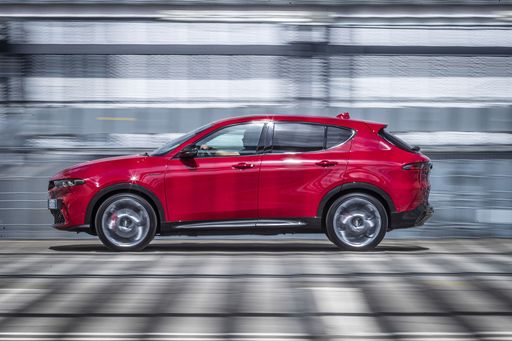
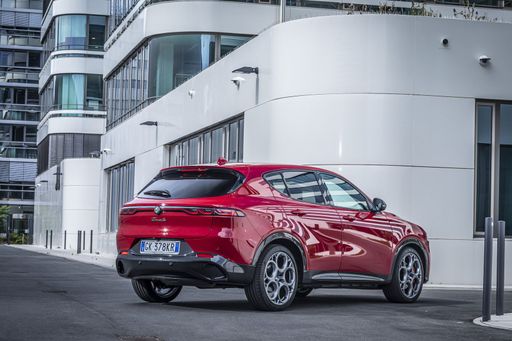
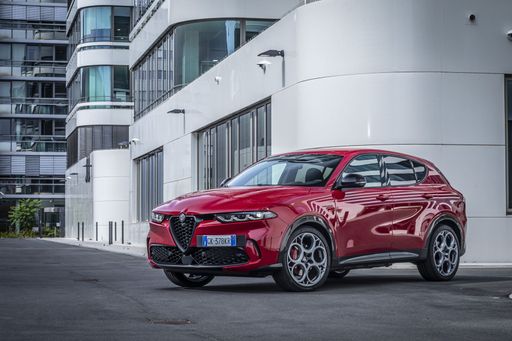
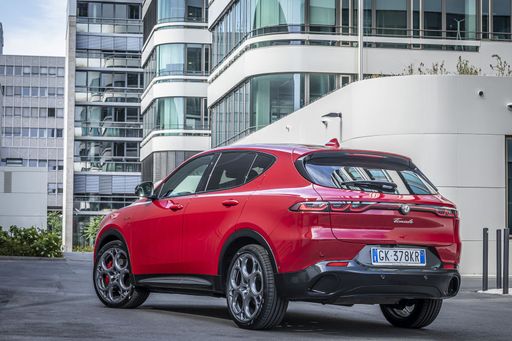
The Alfa Romeo Tonale and Mazda CX-30 both exude unique design languages. The Tonale measures 4,528 mm in length, 1,835 mm in width, and 1,614 mm in height, making it slightly larger than the CX-30, which stands at 4,395 mm in length, 1,795 mm in width, and 1,540 mm in height. This size difference translates into an airier interior for the Tonale, appealing to those who prioritize space. Both models offer seating for five, establishing them as family-friendly choices.

Tonale

Powertrain and Performance

The Tonale offers an impressive variety of engine options, including a plug-in hybrid and mild hybrid petrol versions, with power outputs ranging from 130 to 280 HP. This flexibility, paired with an all-wheel or front-wheel drive system, allows the Tonale to cater to a broad array of driving needs. The plug-in hybrid's 6.2 seconds acceleration to 100 km/h and an electric range of 63 km highlight its performance capabilities.

On the other hand, the Mazda CX-30 is equipped with a petrol mild-hybrid engine. Power ratings vary from 140 to 186 HP, with an acceleration time ranging between 8.3 to 10.3 seconds for 0-100 km/h. It's slightly behind the Tonale in terms of raw power, but the CX-30 excels in delivering a smooth, engaging driving experience with its SkyActiv technology.

CX-30

Efficiency and Eco-friendliness

The Tonale's plug-in hybrid model shines with an outstanding consumption rate of 1.3 L/100 km and a CO2 emission rate as low as 30 g/km, placing it in the B efficiency class. The other engines range in consumption from 5.3 to 5.6 L/100 km, with corresponding CO2 outputs placing them in D and E classes.

The CX-30, while lacking a plug-in hybrid, still maintains efficient operation with its mild hybrid configuration, posting consumption figures between 5.7 to 6.6 L/100 km and CO2 emissions from 129 to 148 g/km. This positions the Mazda largely within the D and E efficiency classes.

Tonale

Technical Innovations

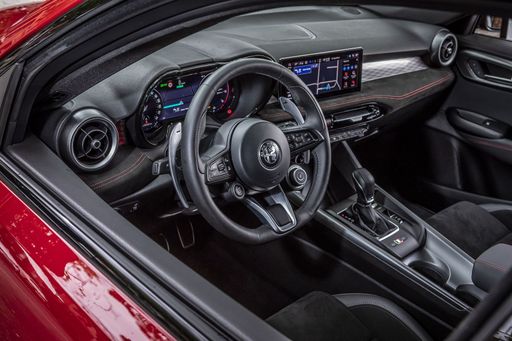
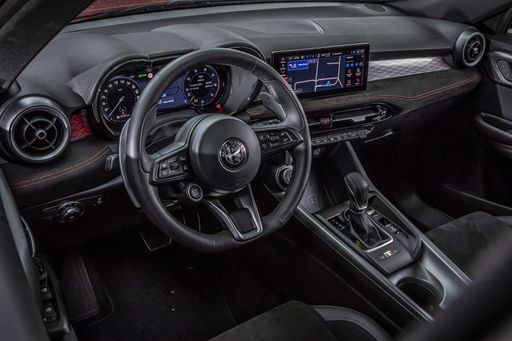
The Alfa Romeo Tonale is at the forefront of innovation with its integration of advanced hybrid technology and dual-clutch automatic transmission. It also offers an interactive driving experience with its cutting-edge infotainment systems.

Mazda's CX-30 capitalizes on its SkyActiv technology to enhance vehicle dynamics and fuel efficiency without compromising on performance. The addition of G-Vectoring Control Plus ensures improved handling, promising a more connected driving experience.

CX-30

Practicality and Usability

In terms of practicality, the Tonale provides a slightly smaller trunk capacity of 385 to 500 liters compared to the CX-30's 422 to 430 liters, but compensates with a superior payload capacity of up to 535 kg. The Mazda’s slightly smaller dimensions might translate into easier maneuverability in urban settings.

Tonale

Conclusion

In conclusion, the choice between the Alfa Romeo Tonale and Mazda CX-30 hinges on individual preferences and priorities. The Tonale is ideal for those who seek cutting-edge hybrid technology, sportier performance, and a more spacious cabin. Alternatively, the CX-30 is an excellent choice for drivers who appreciate a refined driving experience combined with Mazda’s hallmark efficiency and reliability. Both models, however, demonstrate that innovation and practicality are very much alive in the compact SUV segment.

Here’s where it gets real: The technical differences in detail

Tonale

Costs and Efficiency:

Looking at overall running costs, both models reveal some interesting differences in everyday economy.

Mazda CX-30 is substantially cheaper – starting at 25,200 £ , while the Alfa Romeo Tonale costs 35,500 £ . That’s a price difference of around 10,251 £.

Fuel consumption also shows a difference: the Alfa Romeo Tonale uses 3.4 L/100km and is clearly more efficient than the Mazda CX-30 with 5.7 L/100km. The difference is about 2.3 L/100km.

CX-30

Engine and Performance:

Power, torque and acceleration say a lot about how a car feels on the road. This is where you see which model delivers more driving dynamics.

When it comes to engine power, the Alfa Romeo Tonale offers markedly more power – delivering 268 HP compared to 186 HP. That’s roughly 82 HP more horsepower.

When accelerating from 0 to 100 km/h, the Mazda CX-30 is visibly quicker – completing the sprint in 8.3 s, while the Alfa Romeo Tonale takes 10.9 s. That’s about 2.6 s quicker.

There’s also a difference in torque: the Alfa Romeo Tonale delivers visibly more torque with 320 Nm compared to 240 Nm. That’s about 80 Nm more.

Tonale

Space and Everyday Use:

Beyond pure performance, interior space and usability matter most in daily life. This is where you see which car is more practical and versatile.

Both vehicles offer seating for 5 people.

In terms of curb weight, Mazda CX-30 is marginally lighter – 1,455 kg compared to 1,600 kg. The difference is around 145 kg.

Looking at boot space, the Alfa Romeo Tonale offers a bit more boot space – 500 L compared to 430 L. That’s a difference of about 70 L.

When it comes to payload, the Alfa Romeo Tonale carries only slightly more – 535 kg compared to 496 kg. That’s a difference of about 39 kg.

Who wins the race in the data check?

The Alfa Romeo Tonale is clearly superior overall in the objective data comparison.
This result only shows which model scores more points on paper – not which of the two cars feels right for you.

from £35,500
Tonale

Alfa Romeo Tonale

  • Engine Type : Petrol MHEV, Plugin Hybrid, Diesel
  • Transmission : Automatic
  • Drive Type : Front-Wheel Drive, All-Wheel Drive
  • Power HP : 130 - 268 HP
  • Consumption L/100km : 3.4 - 5.6 L/100km
  • Electric Range : 62 km
Alfa Romeo Tonale
Mazda CX-30

Costs and Consumption

View detailed analysis

Engine and Performance

View detailed analysis

Dimensions and Body

View detailed analysis

Alfa Romeo Tonale

The Alfa Romeo Tonale embodies the brand's timeless elegance and sporty DNA, captivating drivers with its bold design and dynamic presence on the road. Inside, the Tonale impresses with a perfect blend of luxury and cutting-edge technology, offering a sophisticated driving experience that remains true to the Alfa Romeo spirit. With its agile performance and distinctive character, the Tonale stands out in the competitive SUV market, appealing to those who seek both style and substance.

details

Mazda CX-30

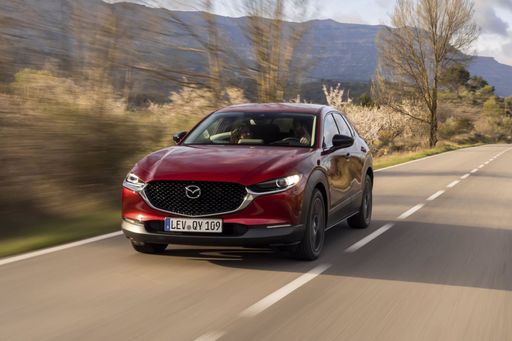
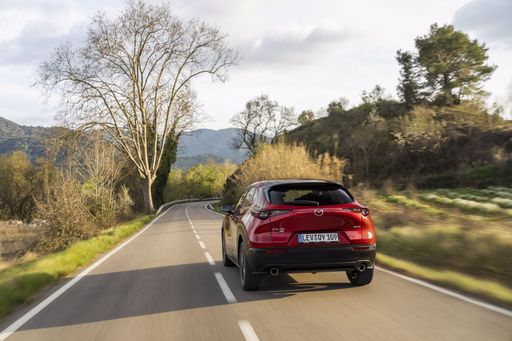
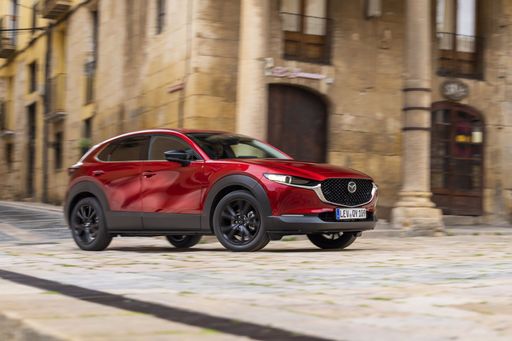
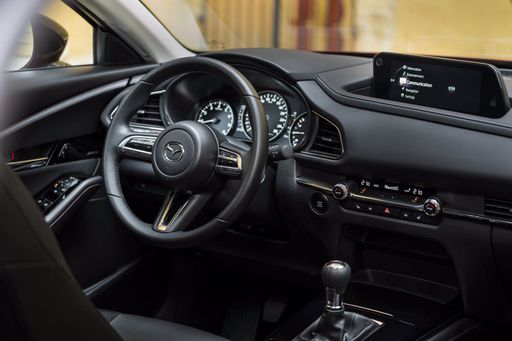
The Mazda CX-30 blends sleek coupe-like lines with the practicality of a compact crossover, feeling more premium than its price tag suggests. It’s a joy to drive for anyone who likes a taut chassis and an interior that treats daily commutes like a small luxury escape.

details
Alfa Romeo Tonale
Mazda CX-30

Costs and Consumption

Price
35,500 - 53,200 £
Price
25,200 - 36,800 £
Consumption L/100km
3.4 - 5.6 L/100km
Consumption L/100km
5.7 - 6.6 L/100km
Consumption kWh/100km
-
Consumption kWh/100km
-
Electric Range
62 km
Electric Range
-
Battery Capacity
-
Battery Capacity
-
co2
77 - 138 g/km
co2
129 - 148 g/km
Fuel tank capacity
-
Fuel tank capacity
-

Dimensions and Body

Body Type
SUV
Body Type
SUV
Seats
5
Seats
5
Doors
-
Doors
-
Curb weight
1,600 - 1,910 kg
Curb weight
1,455 - 1,587 kg
Trunk capacity
385 - 500 L
Trunk capacity
422 - 430 L
Length
-
Length
-
Width
1,835 mm
Width
1,795 mm
Height
-
Height
-
Max trunk capacity
-
Max trunk capacity
-
Payload
510 - 535 kg
Payload
458 - 496 kg

Engine and Performance

Engine Type
Petrol MHEV, Plugin Hybrid, Diesel
Engine Type
Petrol MHEV
Transmission
Automatic
Transmission
Manuel, Automatic
Transmission Detail
Dual-Clutch Automatic, Automatic Gearbox
Transmission Detail
Manual Gearbox, Automatic Gearbox
Drive Type
Front-Wheel Drive, All-Wheel Drive
Drive Type
Front-Wheel Drive, All-Wheel Drive
Power HP
130 - 268 HP
Power HP
140 - 186 HP
Acceleration 0-100km/h
10.9 s
Acceleration 0-100km/h
8.3 - 10.3 s
Max Speed
-
Max Speed
-
Torque
320 Nm
Torque
238 - 240 Nm
Number of Cylinders
4
Number of Cylinders
4
Power kW
96 - 197 kW
Power kW
103 - 137 kW
Engine capacity
1,332 - 1,598 cm3
Engine capacity
1,998 - 2,488 cm3

General

Model Year
2,025 - 2,026
Model Year
2025
CO2 Efficiency Class
D, B, E
CO2 Efficiency Class
D, E
Brand
Alfa Romeo
Brand
Mazda
DriveDuel uses data analysis and artificial intelligence to evaluate vehicle data and create content. Content is regularly reviewed and improved. The displayed prices are estimates based on German list prices, adjusted to the respective country’s VAT. Country-specific registration taxes are not included. This information is not legally binding.