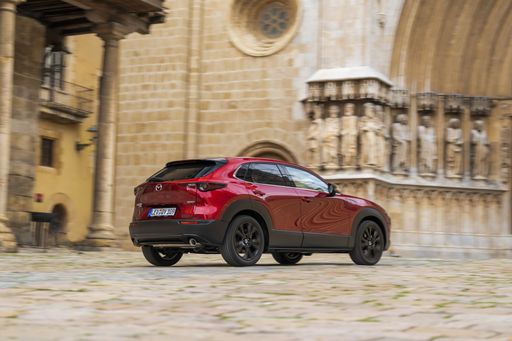
VS

Mazda CX-30 vs Mazda MX-30 comparison

Compare performance (186 HP vs 170 HP), boot space and price (25,200 £ vs 30,800 £ ) at a glance. Find out which car is the better choice for you – Mazda CX-30 or Mazda MX-30?

Mazda CX-30 vs Mazda MX-30: Key differences

Mazda CX-30

4.6 (3 Reviews)
rate
  • visibly cheaper
  • marginally more power
  • only slightly quicker 0–100 km/h
  • noticeably lighter
  • moderately more trunk space

Mazda MX-30

4.6 (1 Reviews)
rate

All details on performance, efficiency, range and trunk space can be found in the technical comparison below – including user reviews for both models.

CX-30

Dynamic Duo: A Comparative Look at the Mazda CX-30 and Mazda MX-30

The automotive world continues to buzz with innovations as brands strive to offer superior products to capture the hearts of car enthusiasts and everyday drivers alike. Mazda has been a prominent name in this pursuit, offering vehicles that combine design, performance, and efficiency. In our latest comparison, we delve into two of Mazda's prized offerings, the Mazda CX-30 and the Mazda MX-30, both of which cater to different driving needs and preferences.
MX-30

Performance and Power: Conventional vs. Electric

The Mazda CX-30, available in both Petrol MHEV and traditional petrol options, stands out with its choice of 186 HP or 140 HP engines. The vehicle offers flexible transmission options, either a manual gearbox or an automatic gearbox, catering to driving purists and convenience seekers. Its acceleration from 0 to 100 km/h ranges from 8.3 to 10.3 seconds, promising a peppy performance for an SUV. Coupled with a torque of 240 Nm, the CX-30 confidently emphasizes its sporty credentials without compromising efficiency, achieving fuel consumption between 5.7 and 6.6 liters per 100 kilometers.

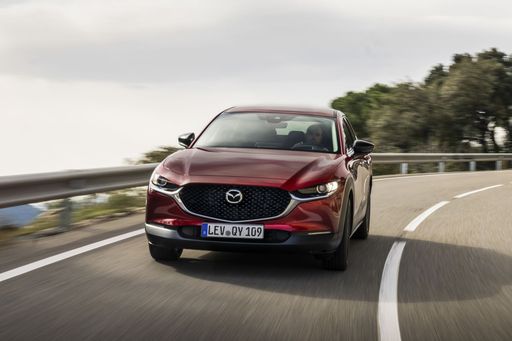
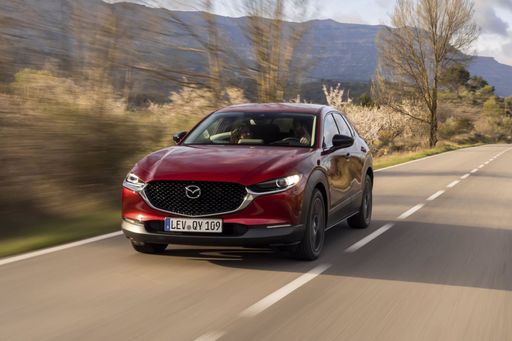
Contrasting this is the Mazda MX-30, a forward-looking electric vehicle available with either pure electric or plug-in hybrid options. Generating up to 170 HP with an electric motor, the MX-30's acceleration comes in at a brisk 9.1 seconds. With torque peaking at 271 Nm, this vehicle delivers a smooth and responsive drive. The electric range varies between 85 to 200 kilometers, depending on the configuration, highlighting Mazda's commitment to sustainability.

CX-30

Design and Dimensions: Comfort Meets Functionality

Both models sit in the SUV category, yet they present distinct approaches in terms of design. The CX-30, with a length and width of 4395 mm and 1795 mm respectively, offers a trunk capacity of up to 430 liters, accommodating both groceries and adventure gear. Thanks to its all-wheel and front-wheel drive options, the CX-30 navigates varied terrains with ease while maintaining a stylish exterior.

The MX-30 is slightly wider at 1848 mm, maintaining a similar length to the CX-30. While its trunk capacity is slightly smaller at 350 liters, the MX-30’s electric and sustainable credentials compensate for its more compact storage. Its unique design features and eco-friendly materials further reinforce Mazda’s innovative push into the electric era.

MX-30

Features and Innovations: Traditional Meets Future

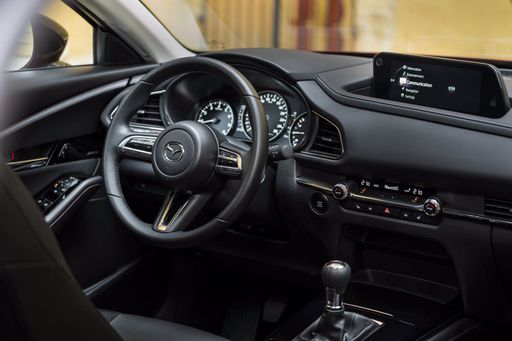
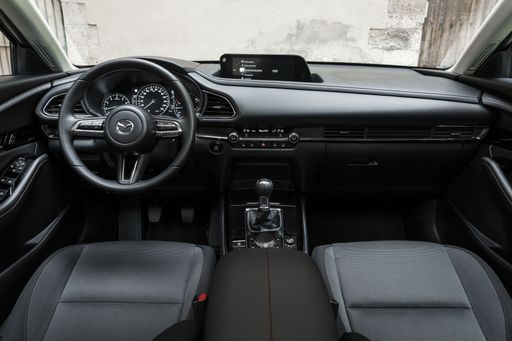
The Mazda CX-30 is emblematic of Mazda’s 'Kodo' design philosophy, emphasizing motion and vibrancy. With a robust set of features — such as advanced safety systems, high-quality interior finishes, and a comprehensive infotainment setup — the CX-30 boosts the driving experience to match it with comfort and control.

Meanwhile, the MX-30 boasts its own set of innovations, particularly in sustainable technology. Its CO2 efficiency, rated between classes A and B, emphasizes an ecological edge. An integrated reduction gearbox, paired with cutting-edge tech interfaces, ensures the MX-30 feels futuristic while providing seamless performance.

CX-30

Conclusion: Which Mazda is Right for You?

The choice between the Mazda CX-30 and the Mazda MX-30 largely depends on individual priorities. The CX-30 offers a blend of traditional performance with modern efficiency, perfect for those who appreciate classic driving experiences but want the flexibility to tackle diverse driving conditions. On the other hand, the MX-30 appeals to the environmentally conscious driver, offering a distinctly sustainable approach without sacrificing style or capability.

As Mazda continues to innovate, both the CX-30 and MX-30 exemplify different dimensions of advancement in the automotive world, catering to a broad range of drivers and preferences. Whether driven by tradition or innovation, Mazda ensures there's an option that resonates with your lifestyle and values.

Here’s where it gets real: The technical differences in detail

CX-30

Costs and Efficiency:

Price and efficiency are key factors when choosing a car – and this is often where the real differences emerge.

Mazda CX-30 is visibly cheaper – starting at 25,200 £ , while the Mazda MX-30 costs 30,800 £ . That’s a price difference of around 5,614 £.

MX-30

Engine and Performance:

Power, torque and acceleration say a lot about how a car feels on the road. This is where you see which model delivers more driving dynamics.

When it comes to engine power, the Mazda CX-30 offers marginally more power – delivering 186 HP compared to 170 HP. That’s roughly 16 HP more horsepower.

When accelerating from 0 to 100 km/h, the Mazda CX-30 is only slightly quicker – completing the sprint in 8.3 s, while the Mazda MX-30 takes 9.1 s. That’s about 0.8 s quicker.

CX-30

Space and Everyday Use:

Whether family car or daily driver – which one offers more room, flexibility and comfort?

Both vehicles offer seating for 5 people.

In terms of curb weight, Mazda CX-30 is noticeably lighter – 1,455 kg compared to 1,849 kg. The difference is around 394 kg.

Looking at boot space, the Mazda CX-30 offers moderately more boot space – 430 L compared to 350 L. That’s a difference of about 80 L.

When it comes to payload, the Mazda CX-30 carries slightly more – 496 kg compared to 402 kg. That’s a difference of about 94 kg.

Who wins the race in the data check?

The Mazda MX-30 stands well ahead of its rival in the objective data comparison.
This result only shows which model scores more points on paper – not which of the two cars feels right for you.

from £30,800
MX-30

Mazda MX-30

  • Engine Type : Plugin Hybrid
  • Transmission : Automatic
  • Drive Type : Front-Wheel Drive
  • Power HP : 170 HP
  • Consumption kWh/100km : 18.3 kWh/100km
  • Electric Range : 85 km
Mazda CX-30
Mazda MX-30

Costs and Consumption

View detailed analysis

Engine and Performance

View detailed analysis

Dimensions and Body

View detailed analysis

Mazda CX-30

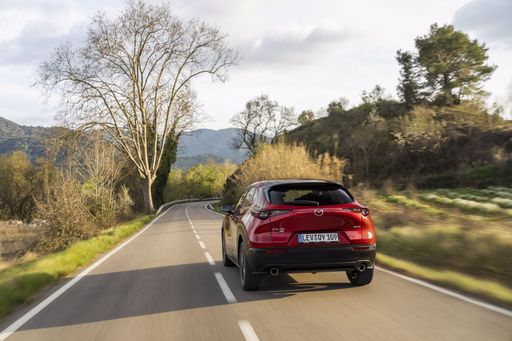
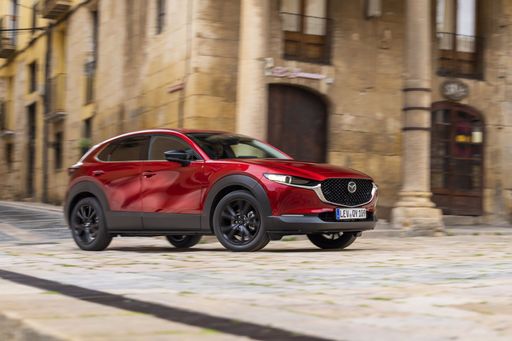
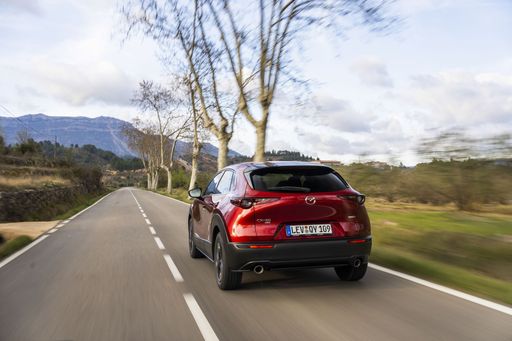
The Mazda CX-30 blends sleek coupe-like lines with the practicality of a compact crossover, feeling more premium than its price tag suggests. It’s a joy to drive for anyone who likes a taut chassis and an interior that treats daily commutes like a small luxury escape.

details

Mazda MX-30

The Mazda MX-30 trades conventional EV practicality for a boutique vibe, wrapping easy urban agility and a stylish, artisan interior into a compact package that stands out in the crossover crowd. It’s ideal for city-minded buyers who value design and driving feel over long-distance trips, and its quirky details prove Mazda can be playful without losing its driver-focused soul.

details
Mazda CX-30
Mazda MX-30

Costs and Consumption

Price
25,200 - 36,800 £
Price
30,800 - 37,100 £
Consumption L/100km
5.7 - 6.6 L/100km
Consumption L/100km
-
Consumption kWh/100km
-
Consumption kWh/100km
18.3 kWh/100km
Electric Range
-
Electric Range
85 km
Battery Capacity
-
Battery Capacity
-
co2
129 - 148 g/km
co2
22 g/km
Fuel tank capacity
-
Fuel tank capacity
-

Dimensions and Body

Body Type
SUV
Body Type
SUV
Seats
5
Seats
5
Doors
-
Doors
5
Curb weight
1,455 - 1,587 kg
Curb weight
1,849 kg
Trunk capacity
422 - 430 L
Trunk capacity
332 - 350 L
Length
-
Length
4,395 mm
Width
1,795 mm
Width
1,848 mm
Height
-
Height
1,555 mm
Max trunk capacity
-
Max trunk capacity
1,137 - 1,155 L
Payload
458 - 496 kg
Payload
402 kg

Engine and Performance

Engine Type
Petrol MHEV
Engine Type
Plugin Hybrid
Transmission
Manuel, Automatic
Transmission
Automatic
Transmission Detail
Manual Gearbox, Automatic Gearbox
Transmission Detail
Reduction Gearbox
Drive Type
Front-Wheel Drive, All-Wheel Drive
Drive Type
Front-Wheel Drive
Power HP
140 - 186 HP
Power HP
170 HP
Acceleration 0-100km/h
8.3 - 10.3 s
Acceleration 0-100km/h
9.1 s
Max Speed
-
Max Speed
140 km/h
Torque
238 - 240 Nm
Torque
-
Number of Cylinders
4
Number of Cylinders
-
Power kW
103 - 137 kW
Power kW
125 kW
Engine capacity
1,998 - 2,488 cm3
Engine capacity
830 cm3

General

Model Year
2,025
Model Year
2,025
CO2 Efficiency Class
D, E
CO2 Efficiency Class
B
Brand
Mazda
Brand
Mazda
DriveDuel uses data analysis and artificial intelligence to evaluate vehicle data and create content. Content is regularly reviewed and improved. The displayed prices are estimates based on German list prices, adjusted to the respective country’s VAT. Country-specific registration taxes are not included. This information is not legally binding.