VS

Renault Clio vs Ford Puma comparison

Compare performance (158 HP vs 168 HP), boot space and price (17,100 £ vs 23,900 £ ) at a glance. Find out which car is the better choice for you – Renault Clio or Ford Puma?

Renault Clio vs Ford Puma: Key differences

Renault Clio

4.7 (1 Reviews)
rate
  • considerably cheaper
  • clearly more efficient
  • barely lighter

Ford Puma

3 (11 Reviews)
rate
  • only slightly more power
  • moderately quicker 0–100 km/h

All details on performance, efficiency, range and trunk space can be found in the technical comparison below – including user reviews for both models.

Clio

In the dynamic world of compact cars, two names often stand out for differing reasons: the Ford Puma and the Renault Clio. As consumers seek stylish yet functional vehicles, both models offer a unique blend of technical prowess and innovative features. In this article, we’ll explore the technical specifications, innovations, and overall performance of these two popular models.

Puma

Body and Design: SUV vs. Hatchback

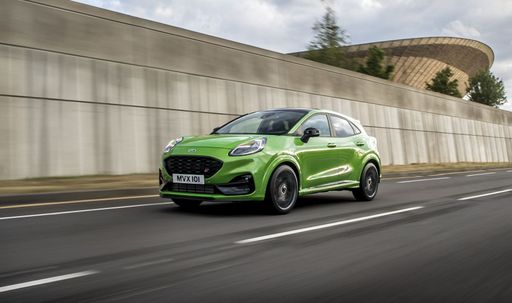
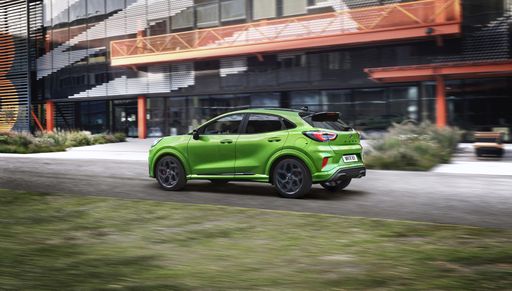
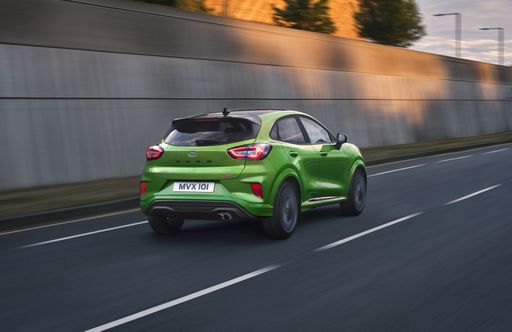
The Ford Puma presents itself as a compact SUV, offering a higher ride height and a commanding view of the road. With a length of approximately 4186 to 4226 mm, a width of 1805 mm, and a height of 1550 mm, it comfortably accommodates five passengers and boasts significant trunk capacity of 456 liters. This SUV appeal, combined with sporty aesthetics, makes the Puma stand out in urban environments.

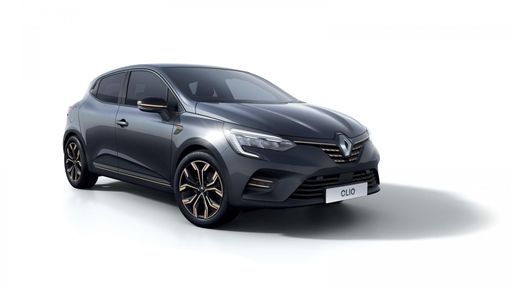
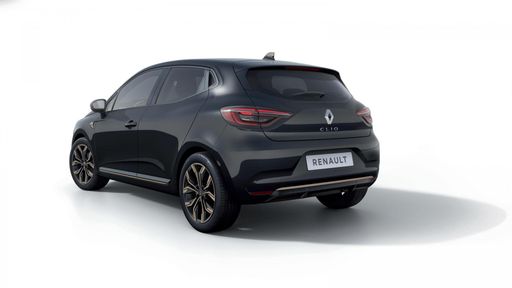
On the other hand, the Renault Clio remains faithful to the hatchback format. Its compact size (4053 mm in length and 1798 mm in width, with a height of 1440 mm) makes it an ideal choice for city driving and parking in tight spaces. Despite its smaller dimensions, the Clio offers a functional trunk capacity ranging from 301 to 391 liters depending on the configuration, balancing style with practicality.

Clio

Engine and Performance: Power and Efficiency

When it comes to engine options, the Ford Puma is equipped with petrol MHEV (mild hybrid electric vehicles). The Puma offers power outputs that range from 125 to 160 HP. Its turbocharged 1.0-liter engine provides lively performance with acceleration from 0 to 100 km/h in as little as 7.4 seconds for the more powerful variants. With consumption ratings between 5.4 and 6 L/100km, the Puma is relatively efficient for an SUV, emitting CO2 levels ranging from 121 to 136 g/km.

The Renault Clio boasts a more diverse engine lineup, including full hybrid, petrol, and LPG options, with power outputs ranging from 67 to 143 HP. Its full hybrid model not only enhances fuel efficiency (as low as 4.3 L/100km) but also helps achieve lower CO2 emissions, starting at just 97 g/km. The acceleration can reach 100 km/h in as fast as 9.3 seconds, proving the Clio is no slouch on the road.

Puma

Transmission and Driving Dynamics

Both vehicles feature front-wheel drive configurations, making them nimble and responsive. The Ford Puma offers either a manual gearbox or an automatic dual-clutch transmission, catering to personal preferences for driving dynamics. Meanwhile, the Renault Clio incorporates automatic, manual, and even a CVT option for its hybrid model, providing versatility for different driving styles.

Clio

Safety and Technology: Innovations Galore

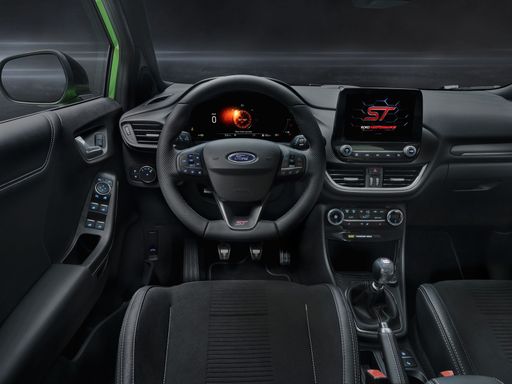
As driving technology evolves, both models prioritize safety and connectivity. The Ford Puma is equipped with Ford's latest driver-assistance features, including adaptive cruise control, lane-keeping assist, and a comprehensive infotainment system with smartphone integration.

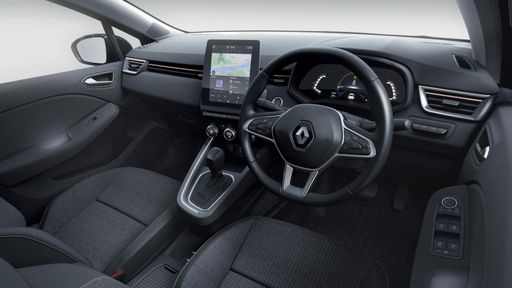
Meanwhile, the Renault Clio steps up to the plate with a user-friendly infotainment system, incorporating a larger touchscreen and seamless smartphone connectivity. With advanced safety features such as emergency braking and blind-spot monitoring, the Clio ensures a secure driving experience.

Puma

Conclusion: The Ideal Companion

Choosing between the Ford Puma and Renault Clio largely depends on consumer needs. The Puma, with its sporty SUV allure and mild hybrid technology, appeals to those seeking a higher driving position and extra cargo space. Conversely, the Clio shines with a variety of efficient engines, compact design, and advanced tech features, ideal for urban dwellers.

Ultimately, both models embody innovative engineering and stylish design, showcasing the capabilities of modern automobiles. Whichever you choose, both the Ford Puma and Renault Clio promise to deliver a blend of performance, comfort, and technology.

Here’s where it gets real: The technical differences in detail

Clio

Costs and Efficiency:

When it comes to price and running costs, the biggest differences usually appear. This is often where you see which car fits your budget better in the long run.

Renault Clio is considerably cheaper – starting at 17,100 £ , while the Ford Puma costs 23,900 £ . That’s a price difference of around 6,857 £.

Fuel consumption also shows a difference: the Renault Clio uses 4.1 L/100km and is clearly more efficient than the Ford Puma with 5.4 L/100km. The difference is about 1.3 L/100km.

Puma

Engine and Performance:

Power, torque and acceleration are the classic benchmarks for car enthusiasts – and here, some clear differences start to show.

When it comes to engine power, the Ford Puma offers only slightly more power – delivering 168 HP compared to 158 HP. That’s roughly 10 HP more horsepower.

When accelerating from 0 to 100 km/h, the Ford Puma is moderately quicker – completing the sprint in 7.4 s, while the Renault Clio takes 8.3 s. That’s about 0.9 s quicker.

There’s also a difference in torque: the Ford Puma delivers clearly more torque with 290 Nm compared to 190 Nm. That’s about 100 Nm more.

Clio

Space and Everyday Use:

Cabin size, boot volume and payload all play a role in everyday practicality. Here, comfort and flexibility make the difference.

Both vehicles offer seating for 5 people.

In terms of curb weight, Renault Clio is barely lighter – 1,202 kg compared to 1,316 kg. The difference is around 114 kg.

When it comes to payload, the Ford Puma carries only slightly more – 469 kg compared to 463 kg. That’s a difference of about 6 kg.

Who wins the race in the data check?

The Ford Puma is barely ahead in the objective data comparison.
This result only shows which model scores more points on paper – not which of the two cars feels right for you.

from £23,900
Puma

Ford Puma

  • Engine Type : Petrol MHEV, Electric
  • Transmission : Manuel, Automatic
  • Drive Type : Front-Wheel Drive
  • Power HP : 125 - 168 HP
  • Consumption L/100km : 5.4 - 5.9 L/100km
  • Consumption kWh/100km : 13 - 13.7 kWh/100km
  • Electric Range : 404 - 417 km
Renault Clio
Ford Puma

Costs and Consumption

View detailed analysis

Engine and Performance

View detailed analysis

Dimensions and Body

View detailed analysis

Renault Clio

The Clio punches above its weight with chic French styling and a surprisingly grown-up cabin that makes city driving feel effortlessly stylish. It's an easy-to-live-with choice that keeps ownership simple and even manages to put a grin on your face when the traffic gets dull.

details

Ford Puma

The Ford Puma is a cheeky compact crossover that blends sporty styling with city-friendly practicality, giving drivers a surprisingly fun and composed ride. With clever storage tricks and a lively personality, it’s a smart pick for buyers who want enjoyment without fuss.

details
Renault Clio
Ford Puma

Costs and Consumption

Price
17,100 - 23,700 £
Price
23,900 - 36,300 £
Consumption L/100km
4.1 - 5.1 L/100km
Consumption L/100km
5.4 - 5.9 L/100km
Consumption kWh/100km
-
Consumption kWh/100km
13 - 13.7 kWh/100km
Electric Range
-
Electric Range
404 - 417 km
Battery Capacity
-
Battery Capacity
-
co2
92 - 115 g/km
co2
0 - 135 g/km
Fuel tank capacity
39 - 42 L
Fuel tank capacity
-

Dimensions and Body

Body Type
Hatchback
Body Type
SUV
Seats
5
Seats
5
Doors
5
Doors
-
Curb weight
1,202 - 1,316 kg
Curb weight
1,316 - 1,563 kg
Trunk capacity
301 - 327 L
Trunk capacity
-
Length
4,116 mm
Length
-
Width
1,768 mm
Width
1,805 mm
Height
1,451 mm
Height
-
Max trunk capacity
1,094 - 1,176 L
Max trunk capacity
-
Payload
453 - 463 kg
Payload
367 - 469 kg

Engine and Performance

Engine Type
Petrol, Full Hybrid
Engine Type
Petrol MHEV, Electric
Transmission
Manuel, Automatic
Transmission
Manuel, Automatic
Transmission Detail
Manual Gearbox, Dual-Clutch Automatic, Automatic Gearbox
Transmission Detail
Manual Gearbox, Dual-Clutch Automatic, Reduction Gearbox
Drive Type
Front-Wheel Drive
Drive Type
Front-Wheel Drive
Power HP
115 - 158 HP
Power HP
125 - 168 HP
Acceleration 0-100km/h
8.3 - 10.1 s
Acceleration 0-100km/h
7.4 - 9.8 s
Max Speed
180 km/h
Max Speed
-
Torque
190 Nm
Torque
170 - 290 Nm
Number of Cylinders
3 - 4
Number of Cylinders
3
Power kW
84 - 116 kW
Power kW
92 - 124 kW
Engine capacity
1,199 - 1,789 cm3
Engine capacity
999 cm3

General

Model Year
2,026
Model Year
2,025 - 2,026
CO2 Efficiency Class
C, B
CO2 Efficiency Class
D, A
Brand
Renault
Brand
Ford
DriveDuel uses data analysis and artificial intelligence to evaluate vehicle data and create content. Content is regularly reviewed and improved. The displayed prices are estimates based on German list prices, adjusted to the respective country’s VAT. Country-specific registration taxes are not included. This information is not legally binding.